For information required when doing business with Shimizu, please refer to “For Suppliers and Subcontractors.”
Policy and Commitment
In our Code of Corporate Ethics and Conduct, we emphasize the importance of maintaining strong partnerships with subcontractors. We view our subcontractors as good partners and prioritize mutual respect for each other's position.
To build a sustainable supply chain with subcontractors, we have established the Shimizu Group Basic Policy on CSR Procurement and the Shimizu Group CSR Procurement Guidelines.
The Shimizu Group Basic Policy on CSR Procurement outlines our basic approach, while the Shimizu Group CSR Procurement Guidelines serve as a practical guide for our subcontractors to put the basic policy into practice. This includes legal compliance, including preventing bribery, respect for human rights, consideration of the environment, and ensuring quality. We also extend these expectations to our subcontractors' business partners (secondary and subsequent suppliers) and encourage them to promote initiatives based on these guidelines.
Related Pages
Shimizu Group CSR Basic Procurement Policy
Shimizu Group acts as a good partner in building relationships with suppliers that are rooted in mutual respect of one another’s perspectives, based on the following Shimizu Group CSR Basic Procurement Policy.
- 1. Compliance with laws, regulations, and company rules, and respect for social norms
-
- Engage in sound and fair transactions, in compliance with domestic and foreign laws and regulations and with company rules, and with respect for social norms.
- Establish a whistleblowing system for employees and suppliers to report violations of laws and regulations. Maintain full confidentiality for and protect whistleblowers.
- 2. Fair, equitable, and good-faith transactions
-
- Provide fair and equitable opportunities for competition to suppliers and strive to respond in good faith.
- Promote fair and equitable transactions as an equal partner. Take a holistic approach to selecting suppliers that considers such factors as price, delivery schedules, technical skills, financial condition, and mitigating environmental impact.
- 3. Building good partnerships with suppliers
-
- Endeavor to sustain and strengthen good partnerships by sharing and resolving various issues and to achieve mutual improvement in technical skills, based on a mutual relationship of trust.
- 4. Respect for human rights
-
- Based on the Shimizu Group Human Rights Policy, respect the human rights of employees and encourage suppliers to respect human rights.
- 5. Consideration for the environment
-
- Based on the Basic Environmental Policy, engage in procurement with respect for the environment. Furthermore, based on the group environmental vision SHIMZ Beyond Zero 2050, work with suppliers to proactively provide positive environmental value to customers and society.
- Encourage all suppliers to engage in environmentally friendly business activities and creation and restoration of the environment.
- Work with suppliers to prevent global warming by reducing CO2 emissions (Ecological Mission 2030-2050), practice the 4Rs to reduce and recycle resources, and preserve biodiversity and water resources.
- 6. Quality and delivery assurance
-
- Endeavor with suppliers to maintain and improve quality.
- Ensure the quality of structures built (strength, functions, durability, precision, workmanship, etc.) and of processes, as requested by customers, by working with suppliers to provide optimal construction work and related services.
- Strive to ensure a feasible construction period to achieve five-day work weeks.
- 7. Promoting health and safety
-
- Endeavor with suppliers to ensure safe and pleasant work environments.
- Work with suppliers to implement accident prevention activities in accordance with the Construction Occupational Health and Safety Management System (COHSMS).
- 8. Pursuing reasonable costs
-
- Work with suppliers to pursue reasonable costs.
- 9. Ensuring information security
-
- Endeavor with suppliers to ensure information security while giving due consideration to safeguarding the confidential information, personal information, and client information we handle in our operations.
- 10. Contributions to society
-
- Work with suppliers to actively contribute to society and local communities as corporate citizens so as to help preserve the abundance of the earth and create a future society in which all people on it can live with happiness.
- 11. Disaster response
-
- Endeavor with suppliers to make preparations in normal times for major disasters, formulate and regularly revise business continuity plans (BCPs), and strengthen risk management systems for times of disaster.
Shimizu Group CSR Procurement Guidelines
- 1. Compliance with laws and regulations and respect for social norms
-
- Comply with relevant laws (construction industry laws, bribery laws, and other penal laws) that apply and respect social norms in countries and territories where suppliers engage in business activities.
- Adamantly refuse improper requests from anti-social forces.
- Maintain transparent and fair relationships with civil servants (including deemed public servants, foreign officials, etc.). Do not engage in bribery whether domestically or abroad, and do not provide improper favors to civil servants or others, neither directly nor indirectly.
- Do not violate or misuse intellectual property rights.
- Report to the appropriate hotline any actual or perceived malfeasance observed in the Shimizu Group's business.
- 2. Fair, equitable, and good-faith transactions
-
- Do not give or receive payoffs.
- Do not engage in behavior against another party such as abuse of an advantageous position or impeding transactions.
- Endeavor to properly disclose information, including corporate information.
- 3. Building good partnerships with business partners
-
- Endeavor to sustain and strengthen partnerships by sharing and resolving various issues with business partners.
- Endeavor to encourage business partners to act in accordance with the guidelines.
- 4. Respect for human rights
-
- Respect the diversity, unique character, and individuality of employees.
- Prohibit discrimination on the basis of ethnicity, religion, nationality, age, sex, gender identity, sexual orientation, disability, or otherwise and harassment that damages the dignity of any individual.
- Prohibit child labor and forced labor in any form, whether domestically or abroad.
- Properly manage employees' working hours, days off, and leave.
- Comply with laws and regulations on wages, such as the legal minimum wage, and endeavor to ensure a wage level in consideration of a living wage.
- Respect employees' freedom of association and right to collective bargaining.
- Perform human rights due diligence, which is a process to identify, prevent and mitigate human rights risks.
- 5. Consideration for the environment
-
- Promote environmentally friendly procurement of materials.
- Endeavor to conserve the environment and reduce environmental impact through managing industrial waste and hazardous chemicals in accordance with applicable laws. Furthermore, practice the 4Rs (Refuse, Reduce, Reuse, Recycle) to reduce construction waste.
- Respect biodiversity, strive for harmony with the natural environment and endeavor to conserve the peripheral environment and water resources.
- Proactively promote zero-carbon initiatives in business activities.
- 6. Quality assurance
-
- Endeavor to develop new technology and materials to further improve quality.
- Steadily perform quality control in all business processes.
- 7. Promoting health and safety
-
- Create safe and sanitary work environments.
- Endeavor to create work environments that are pleasant to work in both physically and mentally.
- Promote accident prevention and endeavor to prevent work-related accidents.
- 8. Pursuing reasonable costs
-
- Regularly improve and hone techniques and construction methods so that costs to be incurred are reasonable in light of specifications, deadlines, market conditions, and so on.
- 9. Ensuring information security
-
- Thoroughly manage and reliably prevent leaks of confidential information, personal information, and client information.
- 10. Contributions to society
-
- With a view to implementing industrial policy, endeavor to continue improving working conditions for skilled workers by taking into account the skill assessment system and the like in the Construction Career Up System (CCUS).
- Encourage social contribution activities that promote local communities' development, such as participating in community events and environmental beautification.
- 11. Disaster response
-
- Endeavor to make preparations in normal times for major disasters and prepare a risk management system for times of disaster.
- Upon ensuring the safety of employees and their families, attempt to protect facilities used by the Shimizu Group, including work sites, while providing support to restore and rebuild disaster areas and promptly restart customers' businesses.
- In order to contribute to local communities, cooperate with national and local governments in rescue and restoration operations.
- 12. Establishment of internal management structure
-
- Establish an internal management structure to comply with the action items listed in the CSR Procurement Guidelines.
Declaration of Respect for Labor Cost Estimates
Improving Skilled Construction Worker Benefits
Shimizu respects the estimates submitted by subcontractors based on the Japan Federation of Construction Contractors Declaration of Respect for Labor Cost Estimates.
Partnership-building Declaration
Shimizu builds sustainable relationships with subcontractors and suppliers that enable them to growalong with our company.
Voluntary Declaration by a Company That Values Skilled Construction Workers
We are working to improve the treatment of skilled construction workers to help secure the workforce that supports the construction industry.
Management System
Shimizu has established the Sustainability Committee (chaired by the President), which deliberates on and determines policies and priority measures related to supply chain management and sustainable procurement, as well as disclosure of supply chain-related information. For particularly important matters, we have established a governance structure in which reports are made to the Board of Directors for oversight.
Shimizu has also established specialized committees and subcommittees as subordinate bodies of the Sustainability Committee to examine supply chain-related issues and submit their findings to the Committee. In addition, we have put in place a structure under which matters deliberated on and determined by the Committee are communicated as instructions to the relevant functional divisions and departments, or under which reports are received from them.
Targets and Performance
| FY2022 | FY2023 | FY2024 | FY2025 | |
|---|---|---|---|---|
| CSR Procurement Guidelines questionnaire survey results on the status of initiatives *Average score (out of 5) |
3.6 | ー (Conducted every 2 years) |
3.7 | ー (Conducted every 2 years) |
| Shimizu Takumi Training Center Participants (persons) |
1,289 | 2,269 | 2,484 | 2,522 |
Initiatives
Supply Chain Management
Supply Chain Education
To ensure that suppliers and subcontractors fully understand the contents of the Shimizu Group CSR Procurement Guidelines, Shimizu provides explanations as part of its nationwide compliance training for suppliers and subcontractors, thereby promoting thorough awareness and understanding.
In FY2023, Shimizu also used remote meetings and other methods, and a total of 6,073 companies participated in the training.
Promotion of Human Rights Due Diligence
From a business sustainability standpoint, Shimizu is advancing human rights due diligence initiatives with a focus on construction workers and construction materials.
Results of Questionnaire Survey on Status of Initiatives Related to Shimizu Group CSR Procurement Guidelines (FY2024)
We have been conducting surveys to ensure that the Shimizu Group CSR Procurement Guidelines are fully understood by our business partners. We have compiled and analyzed the survey results and have been implementing various initiatives to promote compliance with these guidelines in collaboration with our business partners. Specifically, we have interviewed business partners with high scores to learn about their best practices and shared these examples with other partners to help spread these exemplary initiatives. At the same time, we have provided support to partner companies with lower scores by soliciting their challenges and opinions regarding these guidelines and proposing improvement measures based on their feedback. Furthermore, to raise awareness of decarbonization, we have featured case studies of companies working toward decarbonization on our corporate website* and have advanced initiatives to broaden understanding of CSR activities. Furthermore, we have conducted compliance training for our partner companies and promoted awareness of these guidelines and our Human Rights Policy to ensure a shared understanding of the importance of CSR activities. Through these initiatives, and by utilizing surveys, we have been able to advance CSR activities in collaboration with our partner companies and further strengthen the partnership between our company and them. Moving forward, we will continue to work in unison with our partner companies to promote the Shimizu Group CSR Procurement Guidelines and realize a sustainable society.
To Our Partner Companies Committed to Decarbonization (Only in Japanese)
1. Overview of Questionnaire
| Period | October 15 - November 22, 2024 |
|---|---|
| Target | Companies participating in Kanekikai (1,028 companies) [Together with Our Suppliers] |
| Purpose | To ascertain the current status of each company’s initiatives based on the CSR Procurement Guidelines |
| Number of questions | Total of 34 questions in 12 categories |
| Scoring | Self-assessment of the status of own company’s initiatives on scale of 1 to 5※
|
2. Questionnaire Responses
| (1)Fiscal year of implementation | (2)Number of target companies | (3)Number of valid responses | (4)Response rate | (5)Overall average score (out of 5) (Scale of 1 to 5) |
|---|---|---|---|---|
| 2024 | 1028 companies | 767 companies | 75% | 3.7 |
| 2022 | 1035 companies | 701 companies | 68% | 3.6 |
3. Responses and Analysis

Compared to the previous survey (FY 2022), the response rate for the FY 2024 survey increased by 7%.
Regarding the 12 survey items, all items saw an increase compared to the previous survey, led by a 0.27-point rise in “2. Fairness and Impartiality.” The average score rose by 0.1 points to 3.7 points.
The three items—“5. Environmental Consideration,” “11. Disaster Response,” and “12. Internal Systems and Structures”—which had scored below the overall average in the previous survey, saw their scores rise in this round. However, they continue to remain below the overall average.
4. Future Issues
- Raising Awareness of CSR Procurement Guidelines
Through our survey, we will track changes over time in how our partner companies are implementing the CSR Procurement Guidelines and use this as an opportunity to encourage greater awareness of CSR activities among them. - Ensuring Full Awareness Among Partner Companies That Have Not Responded to the Survey
We will further strengthen our outreach to partner companies that have not yet responded to the survey and request that they establish internal systems to ensure they can proceed with initiatives based on the CSR Procurement Guidelines. - Examples of Initiatives
Based on the questionnaire results, we will introduce examples of initiatives and provide specific guidance on the CSR Procurement Guidelines for those items where improved responses are especially needed, namely items that received low scores. - Promoting Proactive Initiatives During Disasters
Through BCP (Business Continuity Plan) drills and earthquake drills, we will share the importance of the construction industry’s role and contribution to local communities during disasters, and continue to promote proactive initiatives.
Securing the Construction Production Framework
Improving the Treatment of Construction Workers
Outstanding skilled worker allowance payment program
Shimizu continuously provides outstanding skilled worker allowances to outstanding foremen who have received the President’s Award at the Health & Safety Promotion Conference in June or on the company’s anniversary in November, as well as to outstanding foremen who have received the Branch Director’s Award at each branch.
Initiatives Aimed at Securing Workers
Workers are aging and the number of young people is declining. Securing workers is therefore an urgent issue for the construction industry.
Shimizu has partnered with subcontractors on conducting job site tours and hands-on experience at job sites, as well as sending visiting lecturers to technical high schools in an effort to acquaint young people who will perform work in the next generation with the construction industry.
We are also endeavoring to make the construction industry more attractive to the next generation by promoting a five-day work week.
We are using a recruitment site and website to support subcontractor hiring activities.
Cross-training Workers in Multiple Skills
Shimizu is working to cross-train workers in multiple skills to broaden the scope of work that skilled construction workers can perform and ensure a sufficient number of workers amid the worker shortage.
We will continue our work on building resilient, productive job sites by making it possible for older workers to work longer and reducing the impact from busy and slack seasons for each type of construction work.
Development of Next-Generation Work-Assist Machines
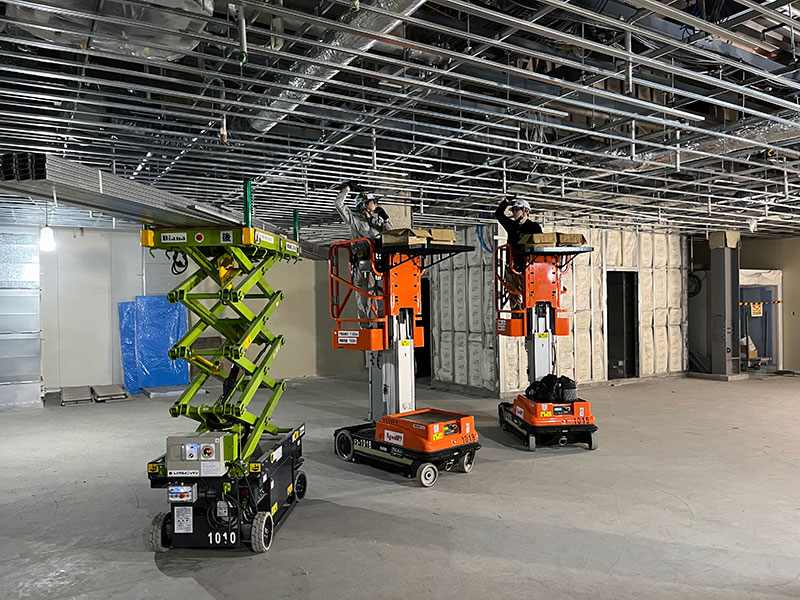
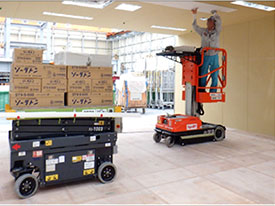
To shorten working hours by improving the treatment of construction workers through workstyle and time-off reform, and to increase productivity in anticipation of future labor shortages, Shimizu jointly developed with Nikken Corporation two systems that enable labor saving and greater efficiency in equipment and finishing work inside and outside ceilings: the Electric Mobile Work Platform and the Wireless-Operated Material Handling/Lifting Device.
By using the two types of work-assist machines together, ceiling materials can be transported, lifted, and installed continuously without the need to set up ceiling scaffolding. This helps save labor and streamline ceiling finishing work in buildings, thereby increasing productivity.
- Introduction to Next-Generation Work-Assist Machines
- Takumi Report on the Jinsei Daiichi website: “Takumi Craftsmanship: What Are Sky Runner and Sky Table?” (Only in Japanese)
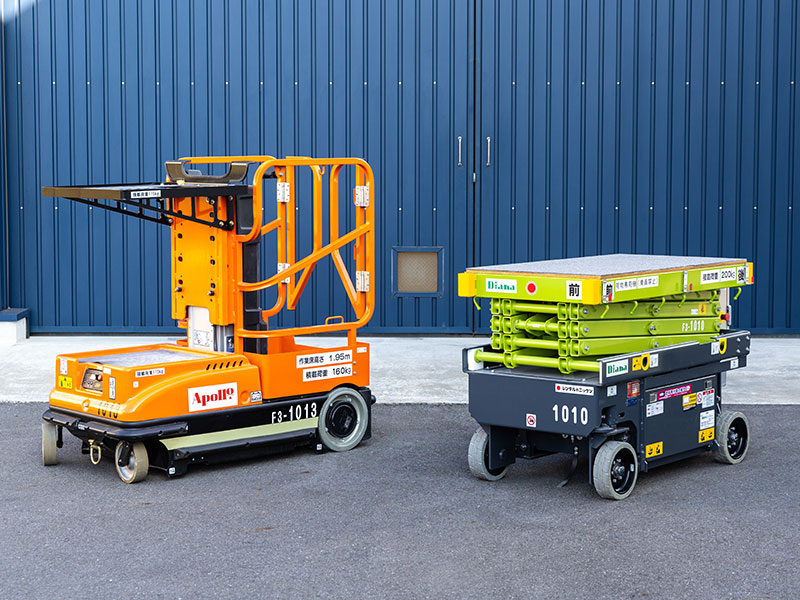
Sky Runner (left) and Sky Table (right)
Health & Safety at Suppliers and Subcontractors
Shimizu Rengo Kanekikai, a Nationwide Association of Subcontractors and Suppliers
The Kanekikai was established as the Kaneki ( ) Koshokai in 1889. The ki symbol was the trademark of the Shimizu carpentry shop at the time. It was composed of the syllable “ki,” the first syllable in the names of Kisuke Shimizu I and Kisuke Shimizu II, and “kanezashi” (
 ) meaning carpenter’s square. It signifies Kisuke Shimizu’s beginnings as a master carpenter.
Shimizu has overcome numerous obstacles through its close bond with the Kanekikai, and have progressed to where we are today with the Kanekikai as an important partner. We will continue to work in tandem with the Kanekikai to pass on technologies, ensure safety, solve many challenges, and contribute to improving the appeal of the construction industry.

Successor Development Training
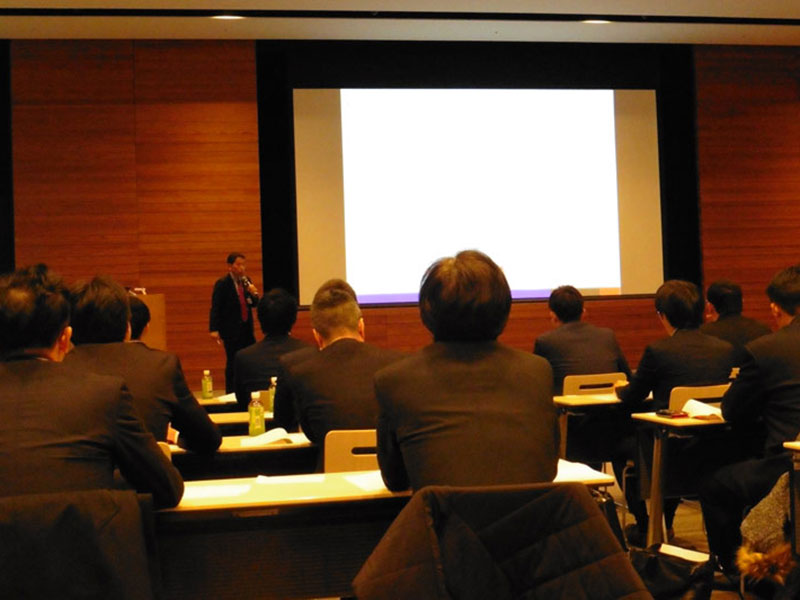
Shimizu provides successor development training to the Kanekikai and members of Shimizu executive management make presentations on Shimizu initiatives, safety, and other topics. We also invite external experts to hold training sessions on The Analects and the Abacus and Eiichi Shibusawa to provide Kanekikai members with a deeper understanding of our corporate credo.
Kanekikai Young Professionals Division
The Kanekikai Young Professionals Division consists mainly of young managers and successors who will be responsible for Kanekikai in the next generation. They engage in various activities to learn essential knowledge required for future top management.
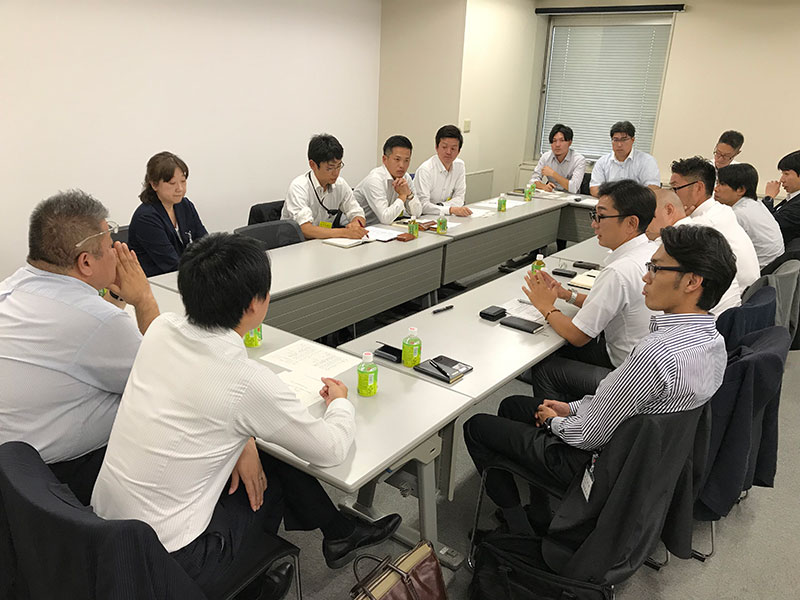
Each chapter conducts job site tours, holds study sessions, and hosts study groups for each occupational category. They also hold opinion exchange sessions with Shimizu top management and other chapters, and are expanding the scope of their activities.
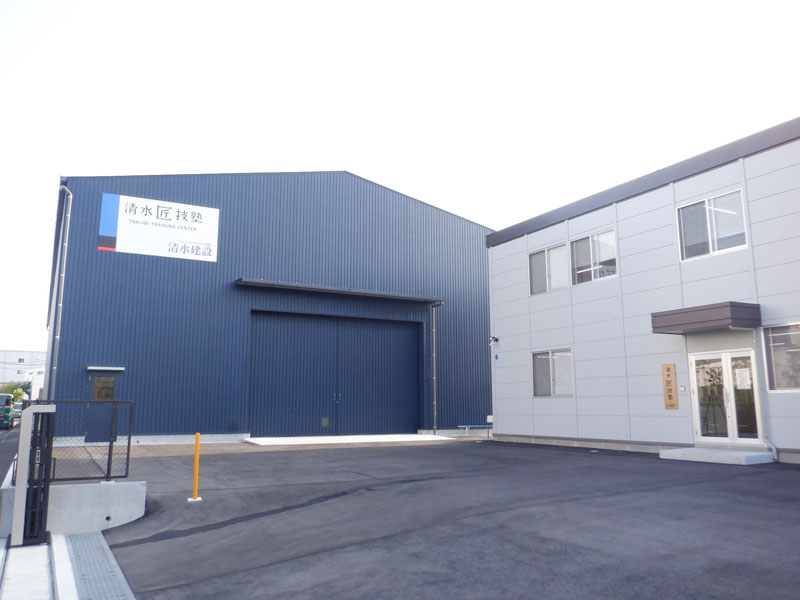
Education and Training Facility: TAKUMI TRAINING CENTER
TAKUMI TRAINING CENTER, our education and training center for skilled construction workers, is operated together with Kanekikai, an association of Shimizu’s suppliers and subcontractors.
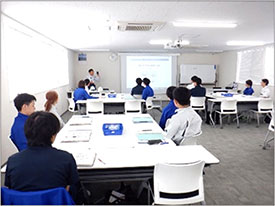
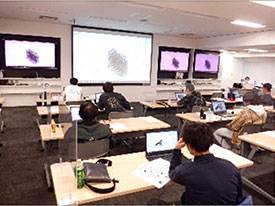
We provide skilled construction workers with education and training curriculum according to their work history and skill level through training for new employees, skill improvement training, and cross-training workers in multiple skills. We also develop and verify tools that help improve productivity.
In fiscal 2022, there were 1,289 participants.
We are adopting a proactive stance on improving the appeal of the construction industry and human resource development by using the training center as a platform for securing and training skilled workers and will work to translate this into an increase in the number of new workers entering the industry.
Core Curriculum
- Training for new hires and first-year and second-year follow-up training
- Qualification training
Foreman refresher training, foreman training for foreign workers, and various special training programs - Job site management training
- Communication skills improvement training
- CAD and BIM training
- Multi-skilled worker skills training
- Construction Verification of productivity-enhancing tools and validation of existing tools. Construction verification and operational training for productivity improvement tools under development and existing tools
Master Craftspeople Supporting Shimizu (Awards Program)
At the President’s Award ceremony held at the Health & Safety Promotion Conference in June and at the President’s Award ceremony held on the company’s anniversary in November, Shimizu recognizes suppliers and subcontractors and foremen who have achieved outstanding results in quality, safety, environmental activities, and related areas. In addition, Shimizu operates a website that introduces the craftspeople who support the company's work.
Memberships and Collaborations
Shimizu personnel have continued to participate in the Supply Chain Subcommittee and the Human Rights Education Subcommittee of the Global Compact Network Japan. By working together with fellow members on the diverse issues present across its broad supply chain, we aim to help realize a sustainable society.
Construction Career Up System
Shimizu will work to reinforce promotion of the Construction Career Up System, a public-private partnership, and aims to improve benefits for skilled construction workers.