Global Trends
Higashi:In recent years, as perspectives on sustainability have diversified, negative views and cautious movements have also begun to emerge. In the United States, some companies are reevaluating their ESG and sustainability policies. Given this situation, how do you view the significance of our company continuing to promote sustainability management?
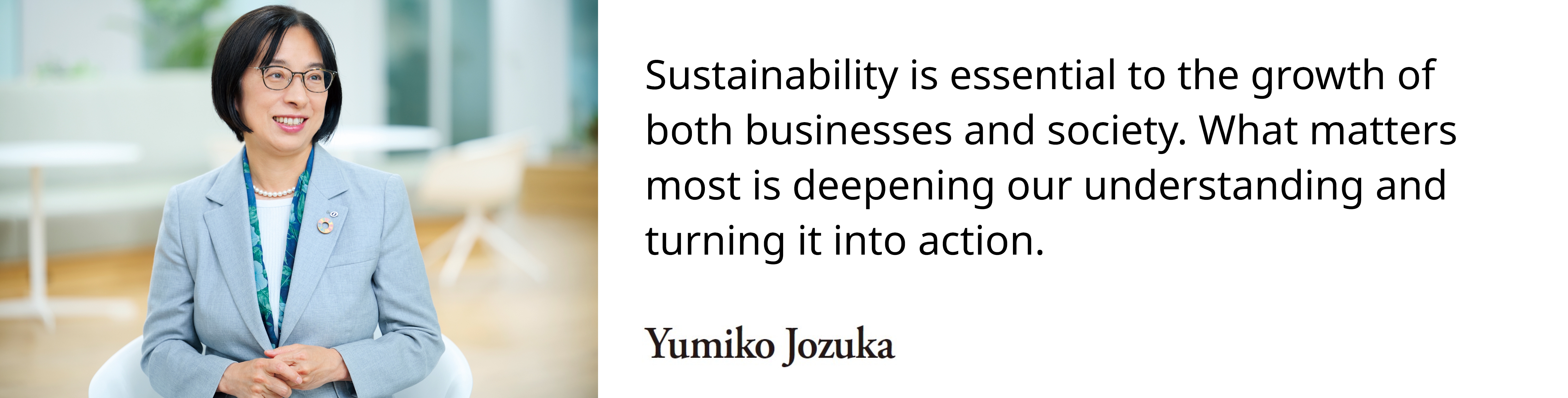
Jozuka:I see the pushback against ESG and sustainability in the United States is temporary. ESG will continue to grow as a global trend, including in Europe. Sustainability is essential to the growth of both businesses and society, so I believe it is crucial for Shimizu to deepen its understanding and turn that understanding into action.
Tamura:I believe sustainability management is not an end in itself, but a means. If the company were to lose sight of that, it would risk falling into a negative cycle of superficial efforts, so-called ESG-washing, where the focus is only on appearances or hitting numerical targets, without real substance or meaningful impact on profits.
Iwamoto:The company’s DNA, cultivated and handed down through generations, is something it must continue to uphold, no matter how the times may change. That is a core value it must never lose sight of.
President:I agree. It is important that we stay grounded in a clear vision of the kind of company we want to be, rather than reacting to short-term changes in the external environment. While adapting to the times is important, I believe we must remain steadfast in upholding the values that should never change.
Higashi:At IR and SR meetings, I often hear questions like, “Sustainability may involve tackling social issues, but how does it contribute to corporate earnings?” Sustainability efforts may not always yield immediate results, but I’d like to hear your thoughts on why it is important to stay committed over the long term.
President:Corporate value cannot be measured solely by financial performance, so I believe sustainability should not be discussed based solely on economic rationality. We view social issues not just as challenges for our company, but as broader concerns facing Japan, the international community, and the planet. We place great importance on how we, as a company, can contribute. I believe it is essential to clearly communicate the significance of these efforts and values to our stakeholders and to proactively share our message.
Tamura:Diversity is vital to sustainability management, but efforts such as promoting women’s participation take time before meaningful results become visible. Looking ahead, I want the company to be a place where everyone with the drive to succeed has opportunities, regardless of age, gender, or nationality. I believe that kind of inclusive environment—where diverse perspectives are freely shared—is what sparks true innovation. I personally hope to support and observe the development of such a corporate culture over the long term.
Kawada:While many sustainability-related KPIs are based on international benchmarks, Japan’s leading companies have long pursued the sustainable growth of business and society, even before the concept of sustainability became widely recognized. I believe this is something the company should continue to uphold as part of its broader pursuit of happiness. Building on that foundation, I believe Shimizu should establish its own unique KPIs to drive more practical and effective initiatives.