

- Corporate Governance Report (PDF: 5895KB)last updated on June 26, 2026
- Criteria for Assessing Independence of Outside Directors and Outside Audit & Supervisory Board Members (PDF: 153KB)last updated: December 24, 2015
-
Basic Policy on Establishing a System of Internal Controls (Only in Japanese) (PDF: 223KB)
last updated on March 9, 2021 - Code of Corporate Ethics and Conduct(PDF:60.3KB)last updated on April, 2025
Basic View
Based on our Credo, The Analects and the Abacus, we strive to fulfill social responsibilities through our business activities, thereby earning a greater degree of trust from our shareholders and investors, and all other stakeholders, including clients, employees, and local communities. We also aim to manage the company in an expeditious, efficient, transparent, and lawful manner to achieve sustainable growth and increase corporate value over the medium to long term.
To achieve this, we have established a structure that enables the Board of Directors and Audit & Supervisory Board Members to appropriately supervise and audit the performance of duties, based on separation of the management strategy decision-making function from the execution of duties function. Concurrently, our basic policy on corporate governance is for our directors, executive officers, audit & supervisory board members, and employees to practice compliance management based on high ethical standards.
Structure
Corporate Governance Structure of Shimizu Corporation
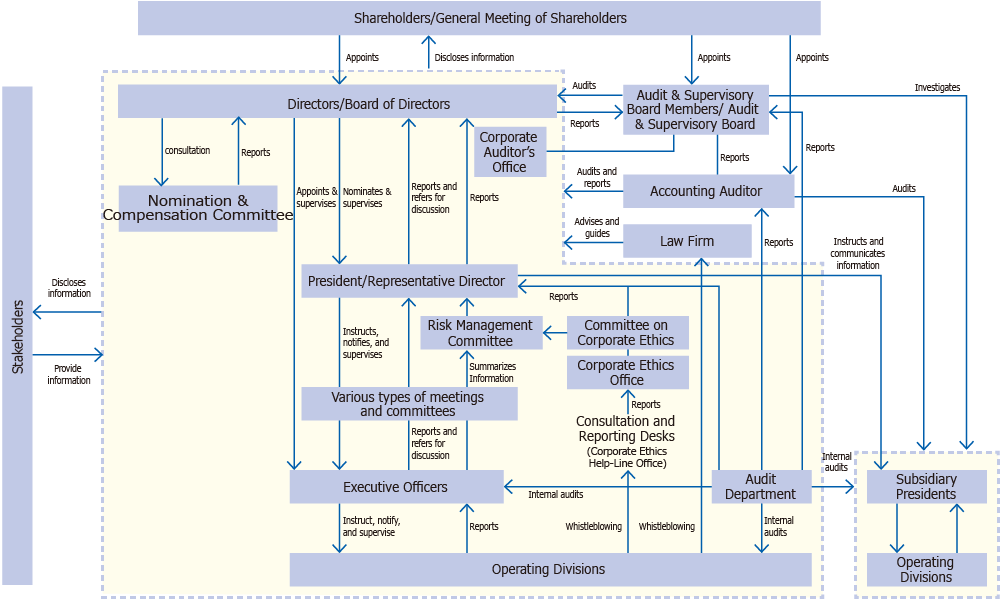
Overview of the Corporate Governance Structure
We have adopted the structure of a company with an Audit & Supervisory Board. We have chosen this system based on the belief that we have established a system to supervise and oversee management from an objective and neutral perspective. This was achieved by limiting the number of directors and introducing an executive officer system to clearly separate the management strategy decision-making and oversight functions from the business execution function, by taking steps to encourage energetic debate at the Board of Directors, and by electing outside directors, other non-executive directors, and outside Audit & Supervisory Board members who maintain a high degree of independence. The concrete structure and implementation status are detailed below.
- One-third or more of the Board of Directors elected are outside directors to strengthen management supervision function, and to promote more energetic debate by the Board of Directors.
- Outside directors and other non-executive directors and outside Audit & Supervisory Board members use their extensive experience and sophisticated insight based on their individual career histories to oversee and supervise management and provide necessary advice as appropriate.
- We established a structure mainly consisting of the head office administrative departments to provide timely information and other materials to assist outside directors and other non-executive directors in performing their management supervisory duties (including tours of offices, job sites, etc.).
- The relevant divisions provide guidance on the Company in general, description of its businesses, and other relevant information to new outside directors and outside Audit & Supervisory Board members.
- Audit & Supervisory Board members audit all duties performed by directors from a fair and impartial perspective.
- The Audit & Supervisory Board Members Office was established as the dedicated organization to support Audit & Supervisory Board members. This office secures the necessary support staff to enable more effective audits by Audit & Supervisory Board members.
- Audit & Supervisory Board members improve the effectiveness of management supervision by attending important meetings and obtaining sufficient information from officers and employees without delay.
- When a Board of Directors meeting is held, the Board of Directors administrative office and other divisions provide explanations in advance to the outside directors, non-executive directors, and Audit & Supervisory Board members.
- Outside directors and other non-executive directors regularly exchange opinions with the chairman and president. They also exchange opinions with outside Audit & Supervisory Board members.
- Regular Outside Officers Meetings are held for outside directors and outside Audit & Supervisory Board members, and regular Outside Directors and Audit & Supervisory Board Members Meetings are held for outside directors and all Audit & Supervisory Board members to facilitate the exchange of opinions.
Main Governing Bodies Established by Shimizu (including discretionary committees and other meeting formats)
Board of Directors
In principle, the Board of Directors meets once a month and, as necessary, to decide matters stipulated by laws and regulations, the Articles of Incorporation, and the Board of Directors Regulations, as well as other important matters, and to supervise the execution of operations. The Articles of Incorporation specifies 12 as the maximum number of directors. These directors consist of executive directors who are highly knowledgeable in each area of our business and non-executive directors, some of whom are outside directors with extensive expertise and experience in their respective specialties. The Chairman and Representative Director serves as the chair of the Board of Directors.
[Names and Titles of Members] (11 as of June 26, 2026)
| Chair | Kazuyuki Inoue (Chairman of the Board and Representative Director) | |||
|---|---|---|---|---|
| Members | Internal Directors | Executive | Tatsuya Shimmura, Yoshito Tsutsumi, Takefumi Saito, Mitsuo Morii, Michiho Yamaguchi | |
| Non-executive | Noriaki Shimizu | |||
| Outside Directors | Junichi Kawada, Mayumi Tamura, Yumiko Jozuka, Yoshio Kometani | |||
(Main Agenda Items)
Election of directors; organizational reform; establishment, revision or repeal of company regulations; formulation and supervision of management policies and strategies; monitoring of progress and growth strategies of each business; risk management; sustainability matters such as climate change and human resources development; feedback on dialogue with investors; reduction of securities holdings; and revision of the standards for referral to the Board of Directors.
[Directors’ Skills Matrix]
The Corporation identified skills (knowledge, experience, and abilities) necessary to respond quickly to changes in the business environment and to achieve sustainable growth and medium- to long-term improvement in corporate value as below. The Corporation aims to maintain the appropriate size and diversity of the Board of Directors and also to optimize the Board of Directors as a whole and maximize its functions by organically combining skills of each director.
| Name | Common skills | Expertise (skills particularly expected, four items at maximum) | |||||||
|---|---|---|---|---|---|---|---|---|---|
| The Analects and the Abacus & Sustainability | Corporate Management | Human Resource Development & DE&I | Global Experience | DX (Digital Transformation) |
Production & Technology | Sales & Marketing | Finance & Accounting | Legal Affairs & Risk Management | |
| Kazuyuki Inoue | |||||||||
| Tatsuya Shimmura | |||||||||
| Yoshito Tsutsumi | |||||||||
| Takefumi Saito | |||||||||
| Mitsuo Morii | |||||||||
| Michiho Yamaguchi | |||||||||
| Noriaki Shimizu | |||||||||
| Junichi Kawada | |||||||||
| Mayumi Tamura | |||||||||
| Yumiko Jozuka | |||||||||
| Yoshio Kometani | |||||||||
The Corporation’s Credo “The Analects and the Abacus” and “Sustainability” are both philosophies that underlie sustainable management, and we consider these qualities as requirements for directors (common skills).
Expertise presents a maximum of four skills particularly expected of skills possessed by each of the director, with ● marks, and does not represent all the knowledge and expertise possessed by the directors.
Each of these skill categories has been determined by the Board of Directors after deliberation by the Nomination and Compensation Committee.
The definition of each skill is as follows:
| Skills | Definition | |
|---|---|---|
| Common skills | The Analects and the Abacus & Sustainability | ・Abilities to formulate policies for sustainability management that fulfills both corporate social responsibility and the pursuit of business opportunities and to supervise business execution, pursuant to the spirit of the Corporation’s Credo “The Analects and the Abacus,” which should be engraved in mind |
| Expertise | Corporate Management | ・Experience of representative director or executive director at a listed company |
| Human Resource Development & DE&I | ・Experience in human resource operations, such as human resource development and the formulation of human resource strategies, or in the promotion of measures related to human resources and DE&I | |
| Global Experience | ・Expertise in international situations or overseas working experience | |
| DX (Digital Transformation) |
・Experience in DX promotion in the business areas, such as building construction, civil engineering, and engineering ・Experience in the promotion of management and business with data-driven and DX approaches |
|
| Production & Technology | ・Expertise in production and technologies based on construction site work experience ・Expertise in the development of production technologies |
|
| Sales & Marketing | ・Experience in the formulation and implementation of sales and marketing strategies that utilize knowledge and connections based on experience in sales activities | |
| Finance & Accounting | ・Expertise in finance and accounting, or experience of CFO at other companies | |
| Legal Affairs & Risk Management | ・Expertise in laws, or experience in risk management operations | |
Audit & Supervisory Board
The Audit & Supervisory Board meets once a month as a rule, and additionally as necessary. It makes decisions on audit policy, audit plans, auditing methods, and other important audit matters, and deliberates on necessary matters concerning audits. The Articles of Incorporation sets the number of Audit & Supervisory Board members at a maximum of five, including three outside Audit & Supervisory Board members. The chair of the Audit & Supervisory Board is an Audit & Supervisory Board member chosen through discussion by the Audit & Supervisory Board.
[Names and Titles of Members] (five as of June 26, 2026)
| Chair | Hiroshi Kobayashi (standing) | |
|---|---|---|
| Members | Audit & Supervisory Board Member (standing) | Tomohiko Hirayama |
| Audit & Supervisory Board Member (part-time) | Kaoru Ishikawa, Toshie Ikenaga, Ko Shikata (all outside Audit & Supervisory Board members) | |
Nomination & Compensation Committee
We have established a Nomination & Compensation Committee to ensure fairness and transparency in the selection and dismissal of directors, Audit & Supervisory Board members and executive officers, as well as evaluation and compensation of directors and executive officers. The scope of responsibilities of the Committee is defined in the Rules of the Nomination and Compensation Committee and other related regulations. The members of this committee consist of five non-executive directors (four outside directors and one non-executive internal director) and one executive director. The committee is chaired by a non-executive director elected every year from among the members.
[Names and Titles of Members] (six as of June 26, 2026)
| Chair | Junichi Kawada (non-executive outside director) | |
|---|---|---|
| Members | Outside Directors | Mayumi Tamura, Yumiko Jozuka, Yoshio Kometani |
| Internal Director | Tatsuya Shimmura (President and Representative Director), Noriaki Shimizu (non-executive) | |
(Main Agenda Items)
Formulation of personnel proposals for directors/executive officers and individual evaluations; total amount of bonuses for directors/executive officers and individual bonuses; individual monthly compensation for the following fiscal year; succession plans; organizational Composition; verification and review of related rules and regulations, etc.
Risk Management Committee
Our Risk Management Committee ascertains and analyzes risks that would have a serious impact on our corporate group, which consists of Shimizu and its subsidiaries. It also determines key items of risk management, and follows up and reports to the Board of Directors. The President and Representative Director serves as the chair of the committee and one standing Audit & Supervisory Board member also attends committee meetings. The roles, authority, and other matters of the Risk Management Committee are defined in the Risk Management Regulations.
[Names and Titles of Members] (14 as of June 29, 2026)
| Chair | Tatsuya Shimmura (President and Representative Director) | |
|---|---|---|
| Members | Yoshito Tsutsumi, Takao Haneda, Takefumi Saito, Mitsuo Morii, Hideo Yokoyama, Tomoaki Harada, Mika Kaneko, Michiho Yamaguchi, Nobuyoshi Kikuchi, Taizo Tsukada, Director of DX Management Office, General Manager of Audit Dept., Hiroshi Kobayashi (standing Audit & Supervisory Board Member) | |
Committee on Corporate Ethics
Shimizu has established the Committee on Corporate Ethics to decide company-wide measures for thoroughly promoting corporate ethics and compliance, implement and follow up on those measures, centralize information on serious misconduct cases, and review and direct preventive measures and recurrence prevention measures. The President and Representative Director serves as the chair of the committee. One full-time Audit & Supervisory Board member and one outside expert (an attorney) also attend committee meetings.
[Names and Titles of Members] (19 as of June 29, 2026)
| Chair | Tatsuya Shimmura (President and Representative Director) | |
|---|---|---|
| Members | Yoshito Tsutsumi, Takao Haneda, Takefumi Saito, Mitsuo Morii, Hideo Yokoyama, Hitoshi Fujita, Mika Kaneko, Michiho Yamaguchi, Nobuyoshi Kikuchi, Senior General Manager of Business Development & Marketing Headquarters, General Manager of Audit Dept., General Manager of General Affairs Dept. and Manager of Corporate Ethics Help-Line Office, General Manager of Legal Affairs Dept., General Manager of Human Resources Dept., General Manager of HR Strategy Dept., Manager of Group Companies Strategy Office, Tomohiko Hirayama (standing Audit & Supervisory Board Member), outside expert (attorney) | |
Executive Officers Council
We have established an Executive Officers Council to communicate important matters and policies decided by the Board of Directors to executive officers and provide instructions to them. The President and Representative Director serves as the chair of this council and members consist of executive directors (other than the chair) and executive officers. Two full-time Audit & Supervisory Board members also attend council meetings.
Evaluating the Effectiveness of the Board of Directors
Our Board of Directors evaluates the overall effectiveness of the Board of Directors once a year.
A summary of the evaluation method and results for fiscal 2025 are provided below:
Evaluation Method
All directors and Audit & Supervisory Board members complete a survey (including anonymous entries and open answers). A self-analysis is performed through discussion by all directors and all Audit & Supervisory Board members at Board of Directors meetings, based on an analysis by a third party (attorney).
| Period covered | April 2025 to March 2026 |
|---|---|
| Dates performed | Board of Directors meetings on March 6 and March 27, 2026 |
| Main items evaluated | Board of Directors composition/operations, management strategy/management supervision function, corporate ethics/risk management, response to sustainability issues, process of determining nomination/compensation, human resources development, communication between outside directors and management, dialogue with shareholders/investors, etc. |
Summary of Evaluation Results
Conclusion: The Shimizu Board of Directors evaluated and determined the Board of Directors as a whole to be operating effectively.
Status of response to issues indicated in the last evaluation of effectiveness in FY2024 (covering April 2024 to March 2025)
The Board of Directors has made consistent efforts to resolve issues and make improvements as follows. The Board of Directors will continue to strive for further improvement.
- Hold in-depth discussions on business portfolio optimization to enhance corporate value
・
Hold more in-depth discussions on growth strategies for each line of business considering the cost of capital at the Board of Directors meetings, and clearly define roles of each line of business in a company-wide scheme to enhance corporate value.
→At the Board of Directors meetings discussions were held on growth strategies and key challenges for each business, including those conducted during off-site meetings.
At the “Dialogue Session on the Mid-Term Business Plan” held for all employees, the senior management explained the roles and expectations for each business, and the feedback received from employees was shared with the Board of Directors. - Further improve internal control and risk management systems to realize teachings of our Credo, the Analects and the Abacus, in our operation
・
Establishment of a more rapid reporting system for high-risk cases, and systematization of reporting on the progress and completion of responses.
→The reporting structure for incidents such as disasters explicitly includes reporting lines to non-executive directors and the Board of Audit & Supervisory Board members. With regard to follow-up progress reports, ensure they are conducted thoroughly by utilizing opportunities such as advance briefings to the Board of Directors. - Enhance the communication between our senior management and outside directors/outside Audit & Supervisory Board members
・
Provide more opportunities for our senior management and outside directors/outside Audit & Supervisory Board members to talk to each other in person outside the Board of Directors’ Meeting.
→Opinion exchange meetings were held between non-executive directors/outside Audit & Supervisory Board members and division heads or branch executives, utilizing time after the Board of Directors meetings or opportunities during construction site visits.
Major issues identified in the effectiveness evaluation.
- Enhance discussions on embedding cost-of-capital awareness and build an appropriate business portfolio.
・
Enforce capital discipline in investment decisions across all lines of business based on discussions regarding the cost of capital, and deepen our deliberations to achieve an optimal business portfolio from a company-wide perspective.
- Further enhance the efficiency and effectiveness of the Board of Directors to facilitate high-level, strategic discussions.
・
Enrich the information provided prior to Board of Directors meetings to improve the quality of deliberations on increasingly diverse and complex matters, thereby expanding the scope of strategic discussions.
- Enhance discussions and visualize the progress of succession planning.
・
Report to the Board of Directors as appropriate regarding development plans for key management personnel and initiatives to enhance the experience of potential successors.
Future initiatives
Based on the results of the evaluation of the effectiveness of the Board of Directors, we aim to enhance the effectiveness of the Board of Directors and further expand and reinforce corporate governance through the PDCA cycle to improve on issues.
Election of Outside Directors and Outside Audit & Supervisory Board Members
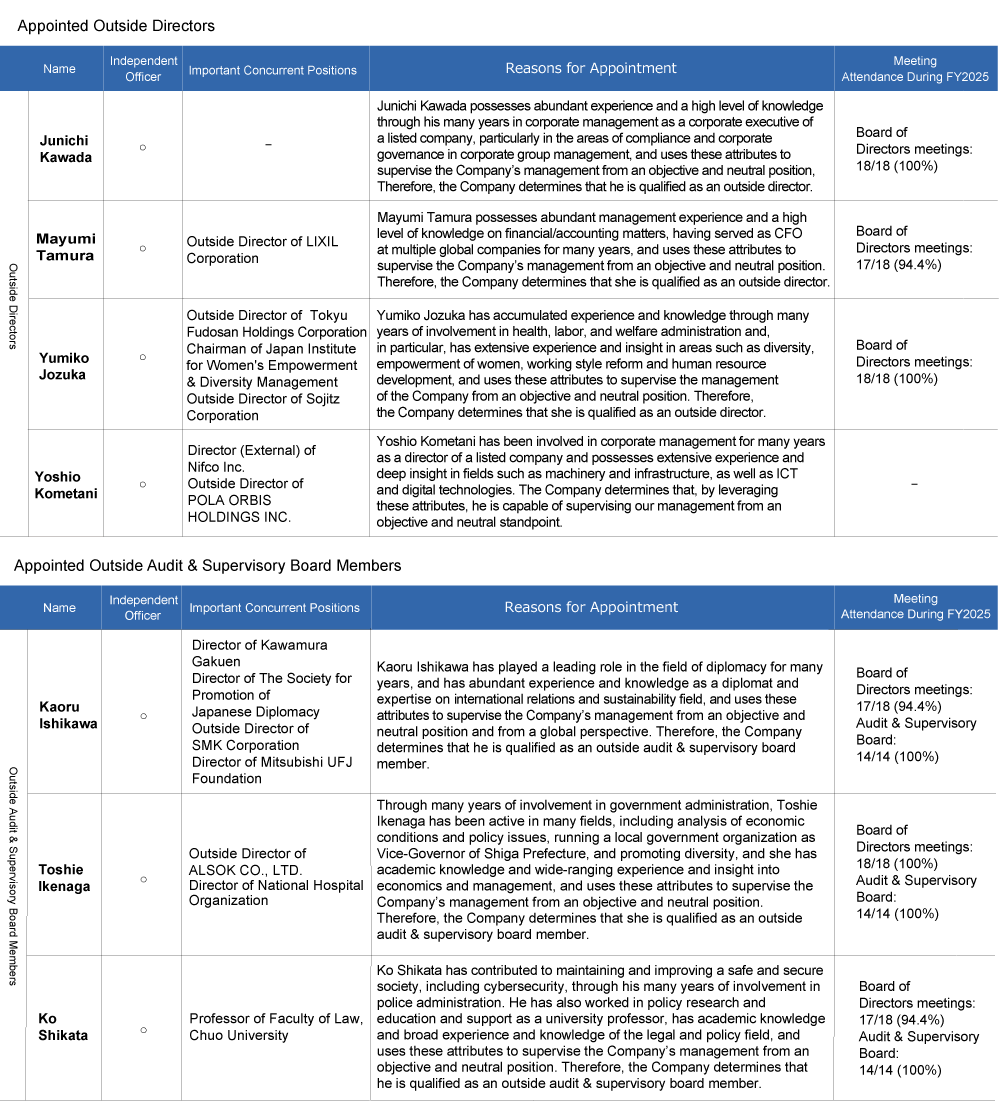
as of June 26, 2026
Criteria for Assessing Independence of Outside Directors and Outside Audit & Supervisory Board Members
Support Structure for Outside Directors and Outside Audit & Supervisory Board Members
We have established a system to provide information to facilitate supervision of management by outside directors and other non-executive directors in performing their duties. The administration departments in the head office play the main role in providing this information in a timely manner. The Corporate Auditor’s Office was established as a dedicated organization to support Audit & Supervisory Board members. A sufficient number of staff members have been secured to assist outside Audit & Supervisory Board members. When a Board of Directors meeting is held, materials are distributed in advance and the Board of Directors administrative office and other divisions provide explanations in advance to the outside directors and the outside Audit & Supervisory Board members.
Directors, Audit & Supervisory Board Members, and Executive Officers
Officer Compensation
Policy on Determining Officer Compensation
The compensation of each director, which consisted of fixed-amount monthly salary as basic compensation, and bonus as performance-linked compensation, and compensation for purchasing the Company’s shares. From fiscal 2026 the previously provided compensation for purchasing the Company’s shares is abolished, and a performance-linked share-based compensation plan (the “Plan”) has been newly introduced, wherein the Company’s shares are delivered as compensation. Thereby, the compensation for directors shall consist of “fixed-amount monthly salary,” “bonus as short-term performance-linked compensation,” and “medium-term performance-linked share-based compensation” under the Plan. The compensation shall be decided through deliberations by the Nomination and Compensation Committee, which is made up of a majority of outside directors and is chaired by a non-executive director, and which was established to evaluate the performance of directors and decide on their compensation in a fair and transparent manner, based on a resolution passed at the Board of Directors.
Non-executive directors including outside directors and audit & supervisory board members are paid only fixed-amount monthly salary for the purpose of enhancing the supervisory functions of management.
The Company, at the Board of Directors’ Meeting held on February 24, 2021, established the Regulations on Director Compensation, that set forth the policy for determining the compensation for each director. Subsequently, at the Board of Directors Meeting held on June 26, 2026, the revision of the relevant regulations in conjunction with the introduction of the Plan was resolved. Its outline is as follows.
Policy on Fixed-amount Monthly Salary as Basic Compensation
Of the compensation, etc. for directors of the Company, the fixed-amount monthly salary as basic compensation is a maximum total of 90 million yen a month (including a maximum of 10 million yen for outside directors) based on a resolution passed at the 117th Annual General Meeting of Shareholders held on June 27, 2019. As of the closing of the 117th Annual General Meeting of Shareholders, the number of directors was 12 (including 3 outside directors).
Compensation for Audit & Supervisory Board members is a maximum total of 13 million yen a month pursuant to a resolution passed at the 89th Annual General Meeting of Shareholders held on June 27, 1991, and is decided through discussions at the Audit & Supervisory Board. As of the closing of the 89th Annual General Meeting of Shareholders, the number of Audit & Supervisory Board members was 4.
Policy on Bonus as Short-term Performance-linked Compensation
Of the compensation, etc. for directors of the Company, bonus as short-term performance-linked compensation for executive directors is a maximum total of 500 million yen a year based on a resolution at the 118th Annual General Meeting of Shareholders held on June 26, 2020, and the Nomination and Compensation Committee deliberates on whether or not a bonus shall be paid and on what amount shall be paid. The bonus amount is calculated according to the following method based on consolidated net income, the final results of the Group’s business activities for a business year. As of the closing of the 118th Annual General Meeting of Shareholders, the number of executive directors was 7. The “earnings coefficient” used to calculate the bonus amount has been updated at the Board of Directors’ Meeting held on January 31, 2025, considering a proposal for deliberation presented by the Nomination and Compensation Committee to make it more clearly defined and provide management more incentives. The new coefficient is applied from the fiscal year starting on April 1, 2025.
(Method of calculating individual performance-based compensation [bonuses])
Consolidated performance*1 x Performance coefficient*2 x Positional index*3 x Individual evaluation coefficient*4 = Individual bonus
- *1. Consolidated net income for the current fiscal year (Net income attributable to shareholders of the Company)
- *2. The Nomination and Compensation Committee determines the earnings coefficient using ordinary income which represents the result of basic business development of the Company and an achievement rate against the targets set for the fiscal year of awards profitability of the construction business, a leading indicator of the business results for coming fiscal years, as main evaluation items. Other items are selected from non-financial KPIs from the Mid-Term Business Plan and added by the Nomination and Compensation Committee based on priority in terms of enhancing mid-to-long term corporate value and objectivity of evaluation. The Nomination and Compensation Committee then considers whether or not there is any material violation of laws and decides the earnings coefficient based on the evaluation value derived by weighted average of each item.
- *3. An index determined for each Director’s position
- *4. The Nomination and Compensation Committee determines individual evaluation indices based on the results of evaluations of the level of achievement of targets set for each director based on interviews with Executive Directors at the beginning and end of the fiscal year. (Evaluation indices range from 65% to 135%)
The multifaceted evaluations cover the short-term performance of each director in addition to their level of contribution to achieving the targets of the Mid-Term Business Plan, their efforts to strengthen the management base, their contributions to sustainability, and their performance as directorships.
Notably, only the non-executive directors of the Nomination and Compensation Committee Members make decisions regarding executive director evaluations.
Policy on Performance-linked share-based compensation
Of the compensation, etc. for directors of the Company, the medium-term performance-linked share-based compensation for executive directors is with the purpose to increase directors’ motivation to improve financial results, and to heighten awareness among directors of their contribution to the Company’s sustained growth and medium- to long-term corporate value by ensuring that they share the risk and reward associated with changes in the stock price with those of shareholders. For the Plan, we have adopted a framework called the director’s compensation Board Incentive Plan (BIP) trust. The Plan is designed to deliver the Company’s shares (or, in some cases, an amount of cash equivalent to the proceeds from the sale of such shares; “Company Shares, etc.”) to executive directors through the trust, based on their positions, the degree of achievement of performance targets, and others during the fiscal years covered by the Mid-Term Business Plan.
The number of Company Shares, etc. delivered to directors is determined by the number of “share delivery points.” Share delivery points are accumulated based on standard points granted annually in June. After the target period of the Mid-Term Business Plan ends, this accumulated value is multiplied by a performance coefficient, which is determined by the Nomination and Compensation Committee, within a range of 70% to 130% based on the achievement of performance targets. For indicators regarding degree of achievement of performance targets, etc., ROE and evaluation items selected by the Nomination and Compensation Committee from financial and non-financial KPIs, etc. listed in the Mid-Term Business Plan are adopted, taking into account the priority for enhancing medium- to long-term corporate value, the objectivity of measurement, and the correlation with performance evaluations used for short-term performance-linked compensation.
According to the resolution of the 124th Annual General Meeting of Shareholders held on June 26, 2026, the upper limit on the number of points to be granted to directors during the target period of the Mid-Term Business Plan is 200,000 points multiplied by the number of years in the target period.
In principle, the directors who satisfy the beneficiary requirements shall receive the delivery of the number of Company’s Shares, etc. calculated based on the above upon the resignation, and the Company shares based on share delivery points shall continue to be held for a certain period after resignation.
Matters concerning Delegation of Decisions on Compensation, etc.
We have established a Nomination & Compensation Committee which consists of a majority of outside directors and is chaired by a non-executive director, to ensure fair and transparent evaluation and compensation of directors and officers through deliberation by the committee based on the resolution of the Board of Directors.
The Nomination & Compensation Committee reviewed compensation for last fiscal year ended March 31, 2025 and discussed the base monthly salary and the amount to be paid as bonuses for each director according to the evaluation of the performance of each director, based on the Rules on Officer Compensation. The committee determined the compensation to be in line with policy determined by the Board of Directors.
Director and Audit & Supervisory Board Member Compensation
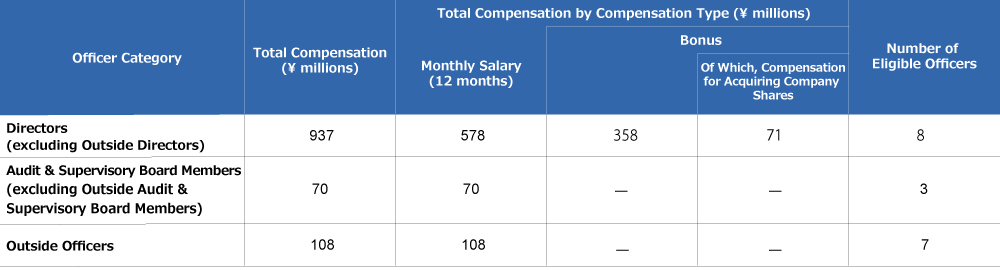
FY2025
Securities Holdings
Policies related to securities holdings
When there is a necessity from the viewpoint of business development, the Corporation holds shares of clients and business partners to “strengthen and maintain relationships.” Holding of major securities is determined by the Board of Directors, taking comprehensive consideration of benefits to the Corporation, acquisition cost, risk of share price changes and other factors. The Board of Directors examines the necessity of securities holdings for individual stocks each year, taking into consideration its economic rationality, including cost, risk, and sales benefits, and for shares that have decreased in significance of shareholding, we divest them while confirming relationships with business partners. Furthermore, even in cases where the significance of holding and economic rationality are recognized, we are proceeding with negotiations for sale while taking into account relationships with business partners and market conditions, in order to achieve the target for reducing securities holdings.
Status of divestment of securities holdings
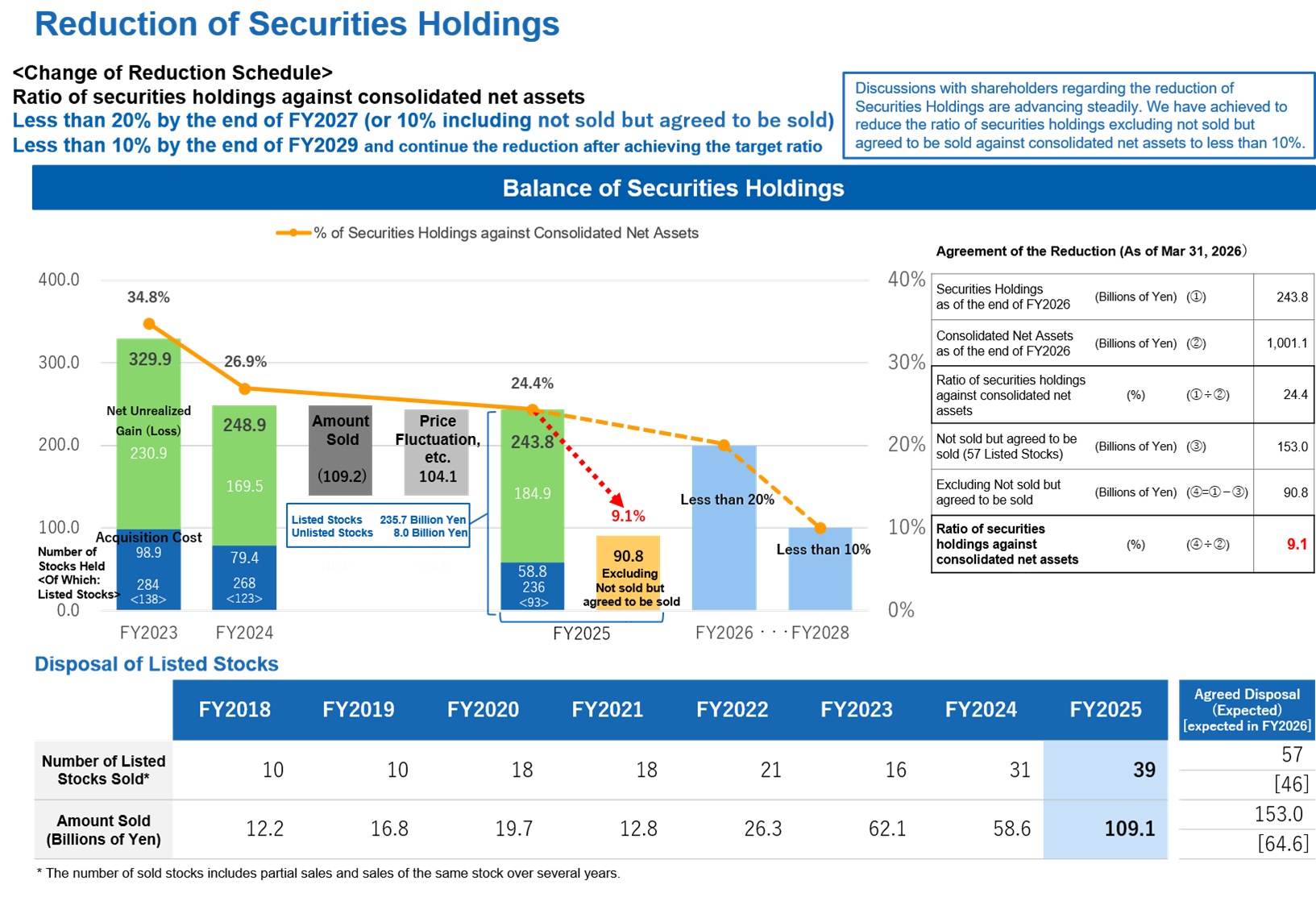
The Corporation has been conducting negotiations with business partners toward achieving the targets for reducing securities holdings set at the Board of Directors meeting held on November 12, 2024 (to 20% or less of consolidated net assets by the end of March 2026, and to 10% or less by the end of March 2027). Due in part to rising share prices, the ratio of securities holdings balance to consolidated net assets as of March 31, 2026 was 24.4%, a slight decrease from the end of the previous fiscal year. However, excluding the shares for which agreement on sale has been reached with business partners, the ratio would be 9.1%.
The Corporation sold shares of 39 listed companies during fiscal 2025 (including shares of which part of the holdings were sold). The proceeds were ¥109.1 billion. From fiscal 2018 to fiscal 2025, the total number of listed companies of which the Corporation sold its holdings was 120 (including shares of which part of the holdings were sold). The proceeds were ¥317.8 billion. As a result, the number of listed companies the Corporation held shares in decreased from 187 as of the end of March 2018 to 93 as of the end of March 2026.
Furthermore, as the business environment surrounding the Corporation, including the situation in the Middle East, is becoming increasingly uncertain, the sale of some shares will be carried out in fiscal 2027 and fiscal 2028 following consultations with the relevant business partners.
Criteria for Exercising Voting Rights Pertaining to Securities Holdings
We exercise voting rights on securities holdings after comprehensively examining the contents of proposals, referring to the Policy on securities holdings above, and judging whether to vote for or against each proposal from the perspective of whether the corporate value of the Company and business partners may increase.
Policy in Case the Cross-shareholder has Expressed their Intention to Sell the Shares
In case the cross-shareholder has expressed their intention to sell the Company’s shares, we will not act to prevent the sale by, for example, suggesting that we will reduce transactions with the company concerned.
Internal Control System Establishment
We have established a Basic Policy on Establishing a System of Internal Controls based on the Companies Act.
Basic Policy on Establishing a System of Internal Controls (Only in Japanese) (PDF: 223 KB)
Last revision: March 9, 2021
Internal Control System Status
We have established a system of internal controls and the Board of Directors makes decisions on the Basic Policy on Establishing a System of Internal Controls to ensure proper operation of the company.
An overview of the operational status of internal control systems in fiscal 2025 is provided below.
| Compliance System |
|
|---|---|
| Risk Management System |
|
| Systems to Ensure Proper Operation of the Shimizu Group |
|
| System for Ensuring Effectiveness of Audits by Auditors |
|