
Partially Floating Structural System
Development and Practical Application of a Seismic-Isolation Structural System Based on Buoyancy
Shimizu Corporation has developed an all-new seismic-isolation structural system that uses the buoyancy of water to support buildings. Known as the "Partially Floating Structural System," this technology has been deployed in an actual structure, and we have confirmed its seismic-isolation effects through earthquake-response measurements.
Since this system offers superb seismic-isolation performance while doubling as a general disaster-alleviation measure through water storage in the cistern, we believe it will be especially ideal for critical facilities that must remain functional in the event of a major earthquake.
Basic Structure

Basic structure of the Partially Floating Structural System and features of its seismic-isolation function
Approximately Half of the Building Weight Supported by Water
The underground section of the building is submerged in water stored in a massive cistern. This means about half of the building weight is supported by water, with the other half supported by seismic-isolation devices (multilayer rubber bearings). The weight supported by these seismic-isolation devices is significantly less than that supported by ordinary seismic-isolation structures, allowing such devices to be more compact and the building's natural vibration period to be extended.
Water Movement Damping
Wave-absorbing devices (porous body units) are installed on sidewalls of the water cistern. By absorbing water wave energy generated by an earthquake, the wave-absorbing devices attenuate building movement.
Characteristics

Factors that disabled provision of medical services in area stricken by Great Hanshin-Awaji Earthquake
(Source: Questionnaire survey conducted by the Japan Institute of Healthcare Architecture)
Superb Seismic-Isolation Performance Achieved through the Buoyancy and Viscosity Provided by Water
The Partially Floating Structural System uses the buoyancy and viscosity of water to achieve enhanced seismic-isolation performance.
The buoyancy of water extends the building's natural vibration period, while the viscosity of water attenuates vibration energy.
In addition to minimizing potential structural damage, this approach should provide superior seismic-isolation performance that prevents damage to non-structural elements.
General Disaster Alleviation through Access to Cistern Water
The structure of the cistern is strong enough to endure the aftershocks following a major earthquake, thus allowing the contained water to be used as an emergency water supply.
The system both minimizes the damage caused by earthquake motions and provides a general disaster-alleviation resource when the supply of essential water is interrupted.
Under ordinary circumstances, water can be used for non-potable functions in lavatories, air conditioning systems, plants, and elsewhere. During summer, the difference between ambient temperatures and the water temperature can be used to conserve energy.

Study example of the Partially Floating Structural System used in a mid-size hospital
Possible Applications for Facilities
Use of Partially Floating Structural Systems for critical facilities is expected to increase, as the functions provided by such facilities are indispensable in the event of a major earthquake. The Partially Floating Structural System is especially suited to buildings constructed in coastal cities with at-risk ground conditions.

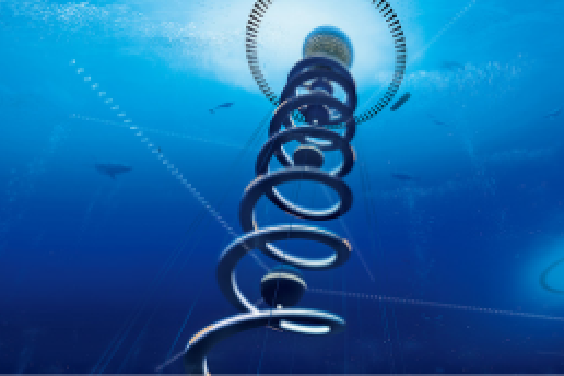
In addition to use with ground-based facilities, the Partially Floating Structural System can be used to build artificial seismic-isolation platforms on relatively calm bodies of water. By adopting a semisubmersible structure consisting of buoyant units placed underwater, we can create stable, buoyant artificial land areas virtually unaffected by tides.

Practical Applications
The construction of the Wind Tunnel Testing Laboratory, completed in August 2005 on the premises of the Shimizu Institute of Technology, marked the world's first actual implementation of the Partially Floating Structural System. Half the 2,900 tons of this building's weight is supported by water. The multilayer rubber bearings that support the remaining building weight have smaller dimensions than are typical for a building of this size.

Wind Tunnel Testing Laboratory building featuring the Partially Floating Structural System (completed in August 2005 on the premises of the Shimizu Institute of Technology)
Verification of Seismic-Isolation Effects
We confirmed the effectiveness of the seismic isolation provided by the Partially Floating Structural System during the earthquake occurring offshore from Miyagi prefecture on August 16, 2005.
During this earthquake, we confirmed that the Partially Floating Structural System offers excellent seismic-isolation performance in the event of a large-magnitude earthquake that might overwhelm ordinary seismic-isolation structures, and that the response analysis model based on fluid dynamics delivered highly accurate predictions.
In the event of a major earthquake, the Partially Floating Structural System reduces response acceleration 30% to 50% more than is achieved by ordinary seismic-isolation structures.