

Instantly create thousands of patterns, visualize data, and generate optimal solutions.Pedestrian Flow Simulation

Problem
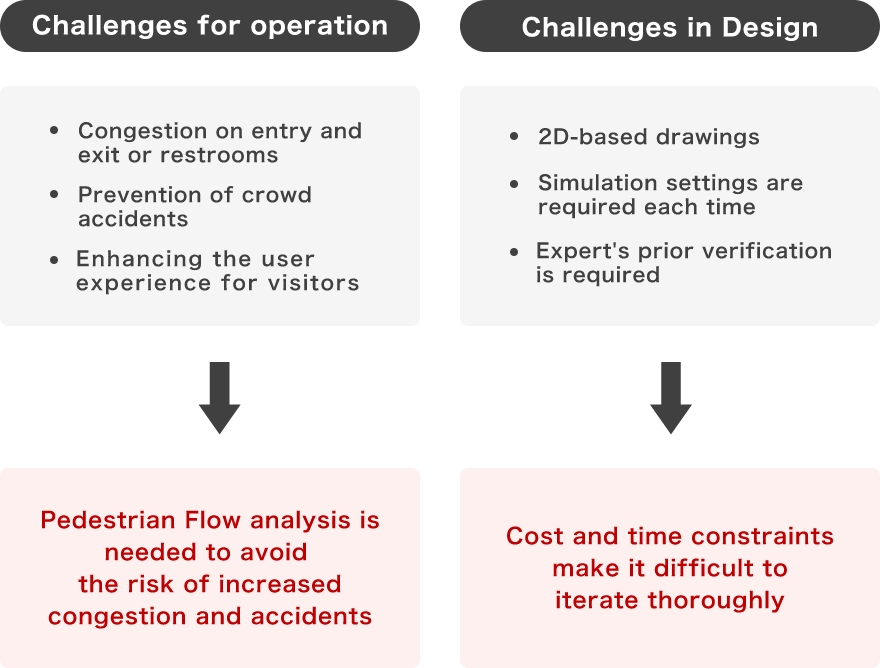
What are the urgent challenges that spaces where many people gather are facing?
Evolving pedestrian flow simulation for arenas, stadiums, and commercial facilities.
In large-scale facilities such as arenas, stadiums, and commercial facilities where many people gather, the importance of understanding pedestrian flow is increasing.Reducing wait times and congestion and preventing crowd accidents are key challenges; the goal is to avoid “stagnation” and “congestion” while enhancing the experience for facility users.
“Pedestrian flow simulation” is the solution to these problems.When designing large-scale facilities, it is necessary to understand pedestrian flow at the early design stage and consider appropriate width settings and optimal layout planning for architectural functions.
However, it has been extremely difficult to simultaneously conduct design studies and performance evaluations that incorporate pedestrian flow simulation during the early design stage, which involves many uncertainties.

Next-generation
pedestrian flow simulation made possible by
Shimz DDE Pedex+
Area Module ModelAMM
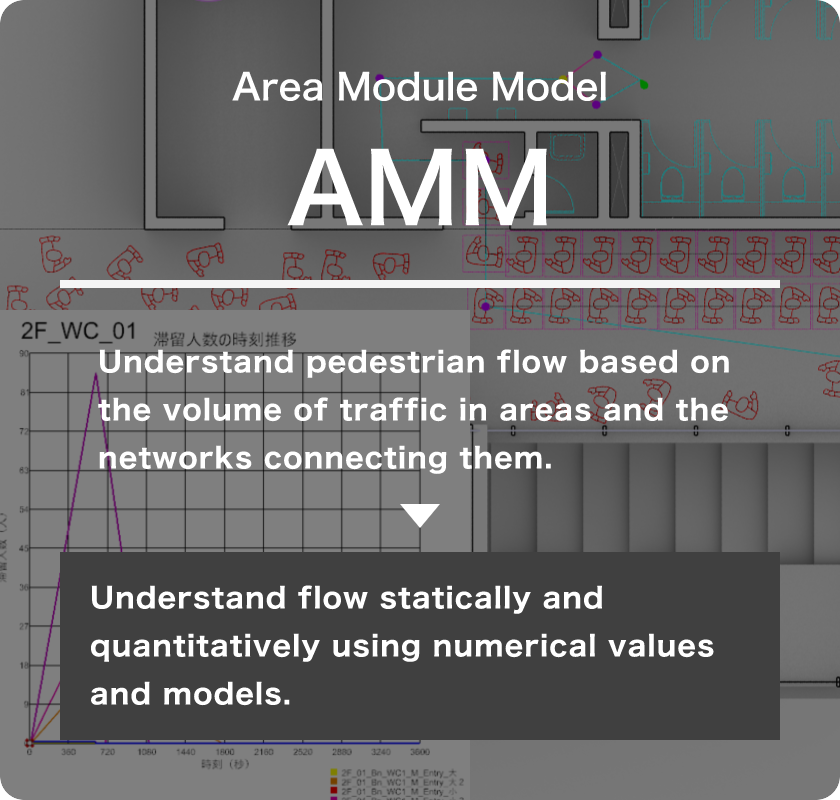
Understand pedestrian flow based on the volume of traffic in areas and the networks connecting them.
Understand flow statically and quantitatively using numerical values and models.
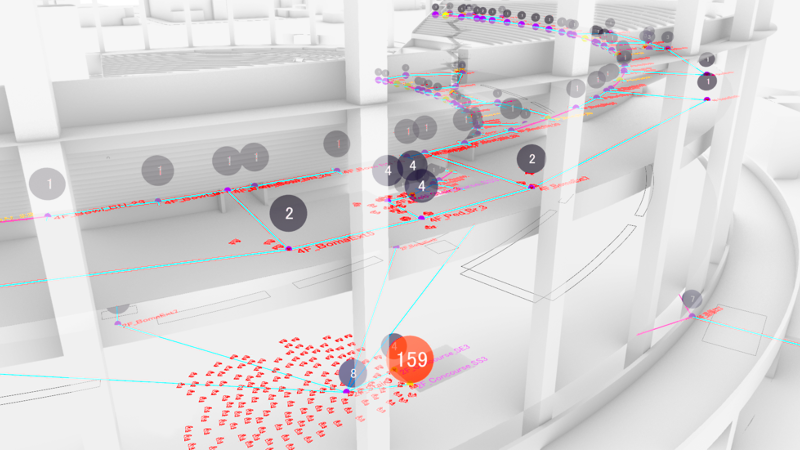
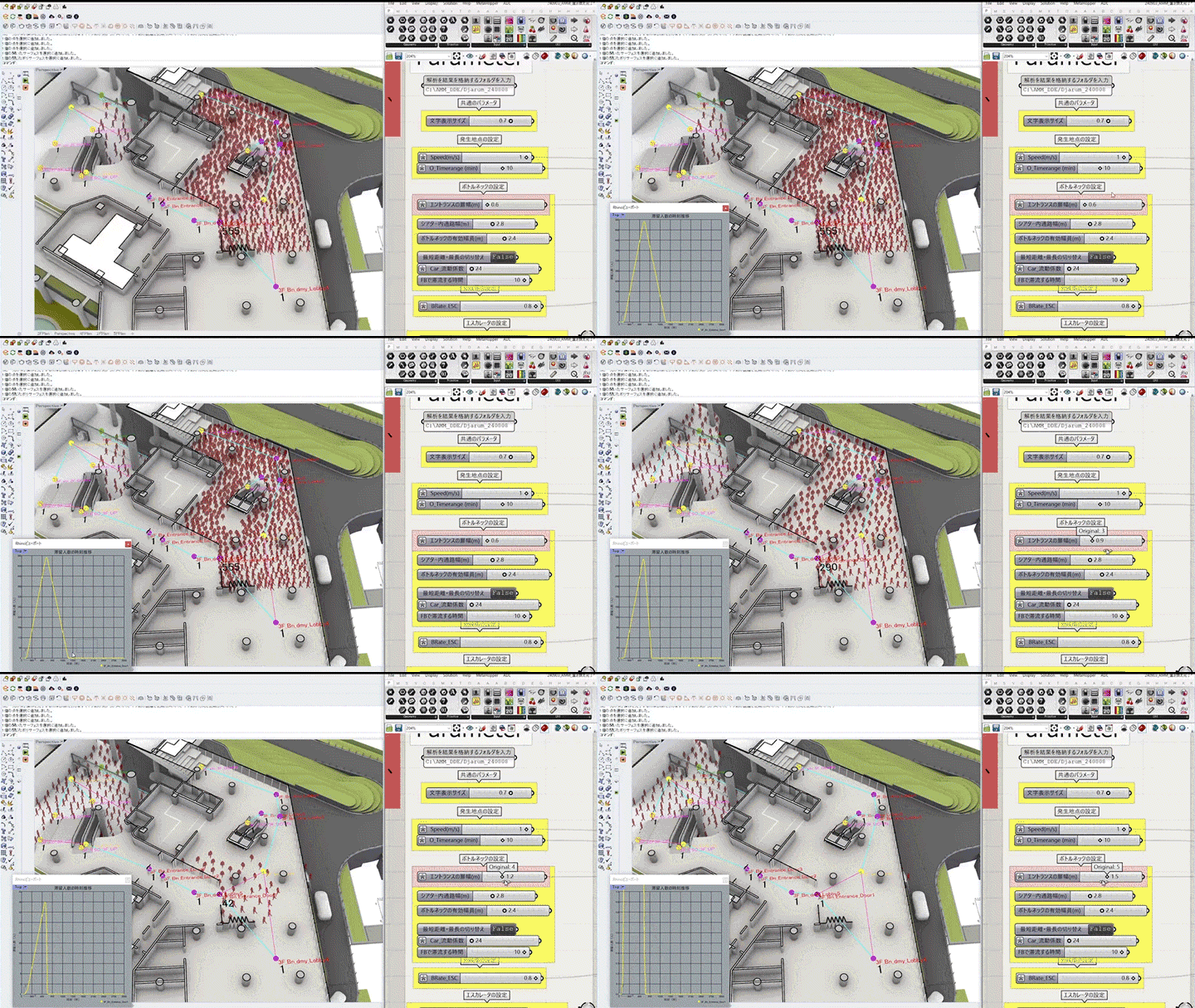
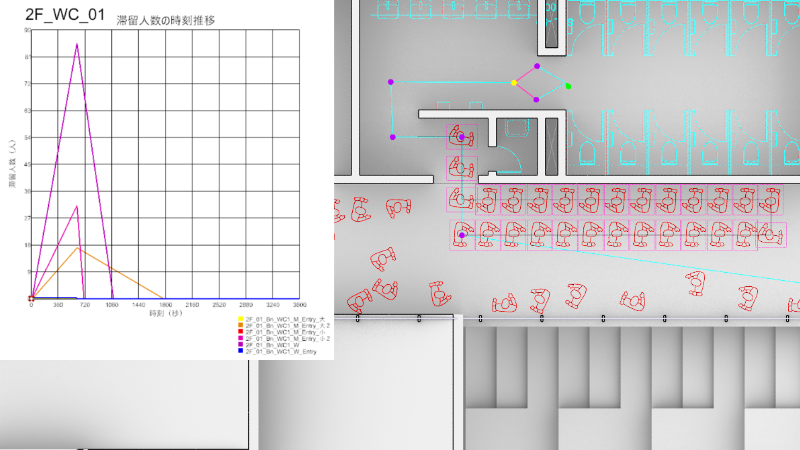
- Examine required passage widths and consider queues and spaces based on the number of people stagnating.
- Can be used for various simulations, such as examining restroom queues during congestion.
Multi Agent SimulationMAS
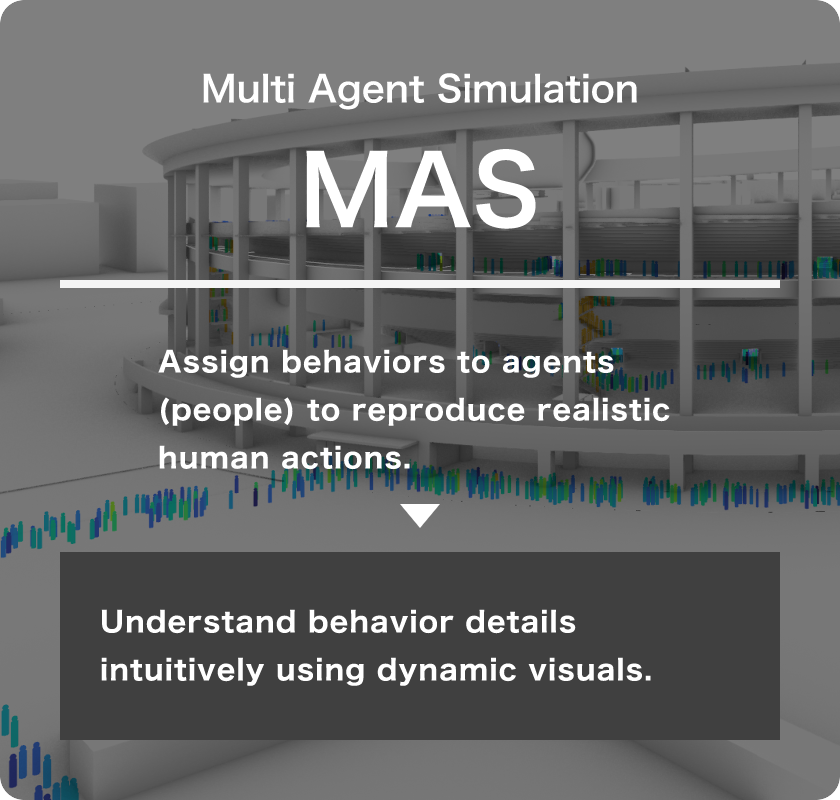
Assign behaviors to agents (people) to reproduce realistic human actions.
Understand details and gain intuitive insights through dynamic visuals.
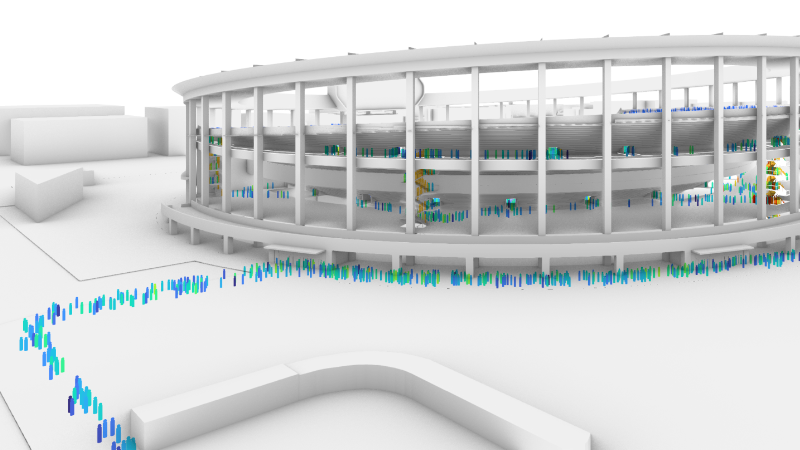
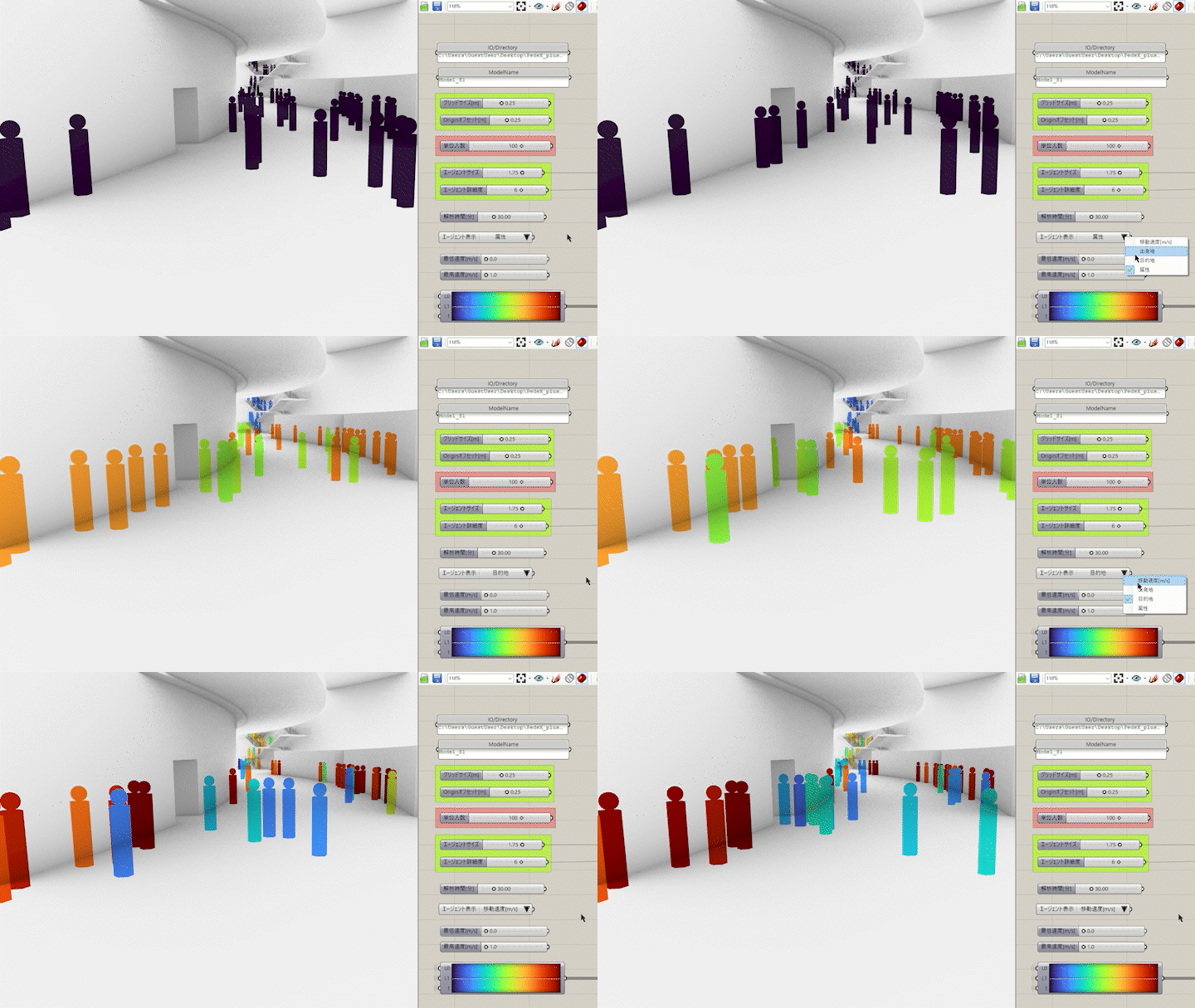
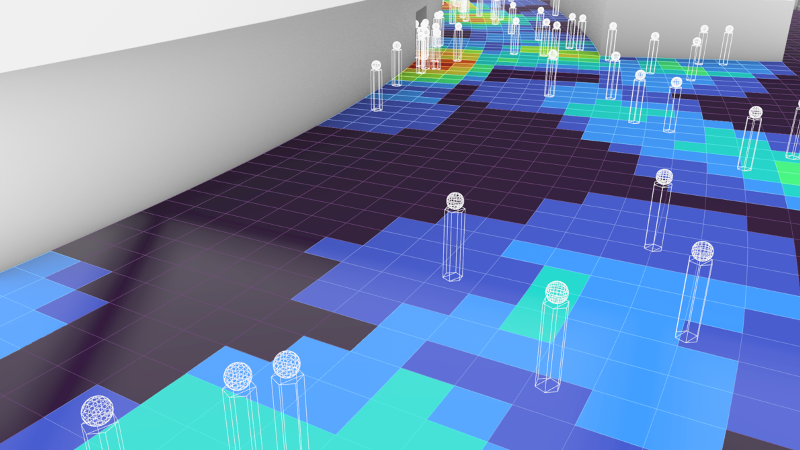
- Concrete visualization of congestion status using color maps for agents and spaces.
- Can be used for creating easy-to-understand presentation materials and facilitating consensus building.
Shimz DDE Pedex+ is a new pedestrian flow simulation system based on Rhinoceros and Grasshopper—3D modeling tools used by designers in their daily work—that enables simultaneous design study and pedestrian flow performance evaluation for various facilities. By setting variable factors that affect pedestrian flow as parameters, designers can instantly evaluate the suitability of each performance and select the optimal plan. It also enables the immediate output of diverse visuals that allow anyone to recognize pedestrian flow performance at a glance. By making such specialized studies accessible to designers, we aim to make the design process that considers pedestrian flow the standard, realizing a future of vibrant, congestion-free cities where people don’t have to wait in line for restrooms.
Features
New possibilities for design with three functions
1
Shimz DDE Pedex+ Function
Evaluate normal behavior with diverse parameters.
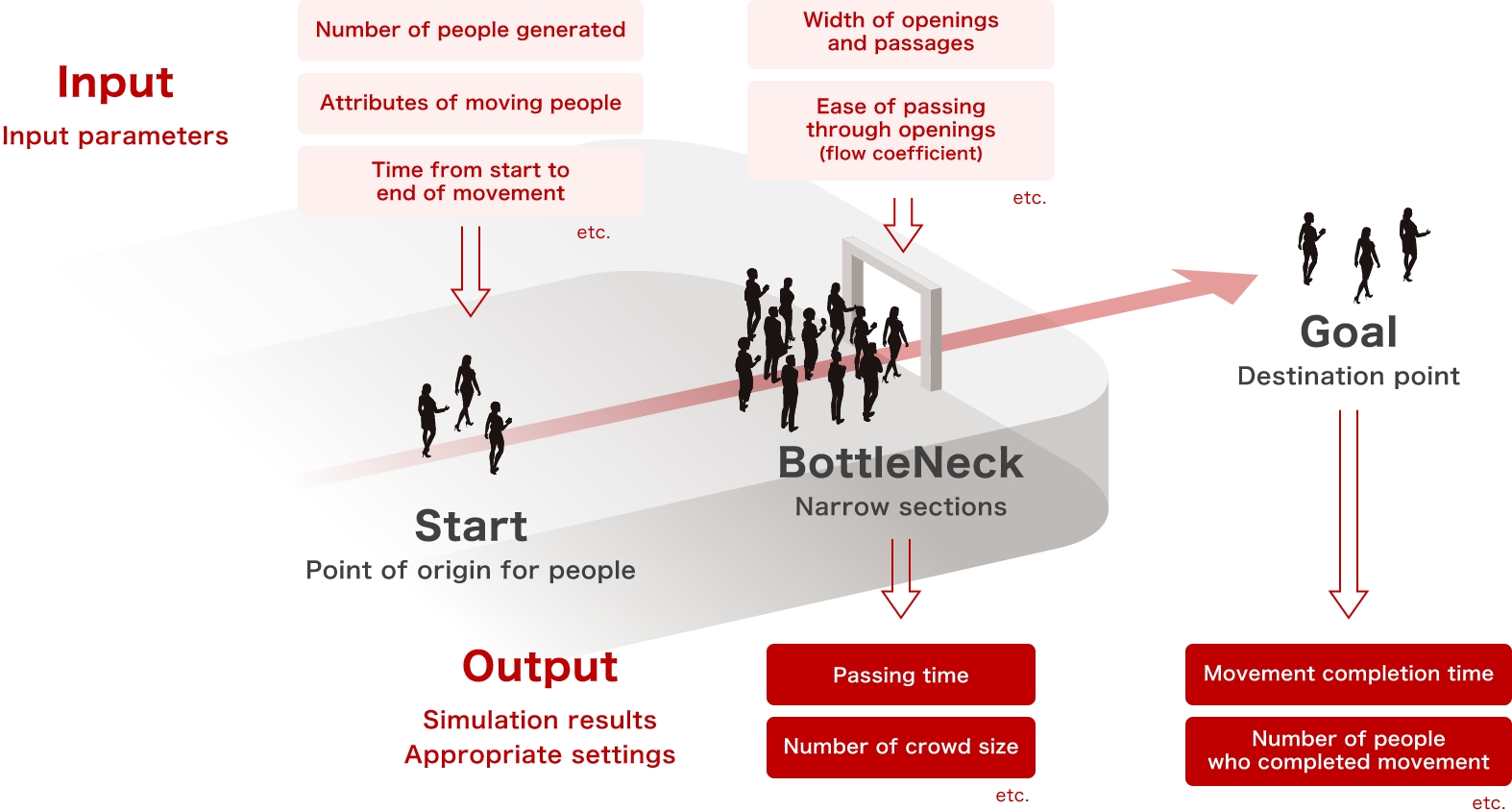
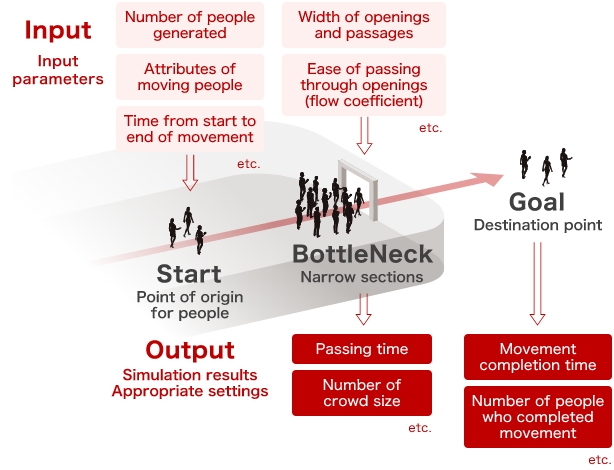
Unlike evaluations based on conventional evacuation behavior, Shimz DDE Pedex+ is characterized by its ability to evaluate diverse behaviors under normal conditions. For example, by inputting parameters such as “number of people generated, attributes of moving people, and time from start to end of movement” at generation points, and “width of openings/passages and ease of passage” at bottleneck areas, the system calculates “passage time and number of people stagnating” at bottlenecks, and “movement completion time and number of people” at destinations. In other words, it becomes possible to reproduce the crowd behavior of tens of thousands of people even with early-stage 3D models during the design study phase.
2
Shimz DDE Pedex+ Function
Always achieve high-precision simulation based on actual measurement results.
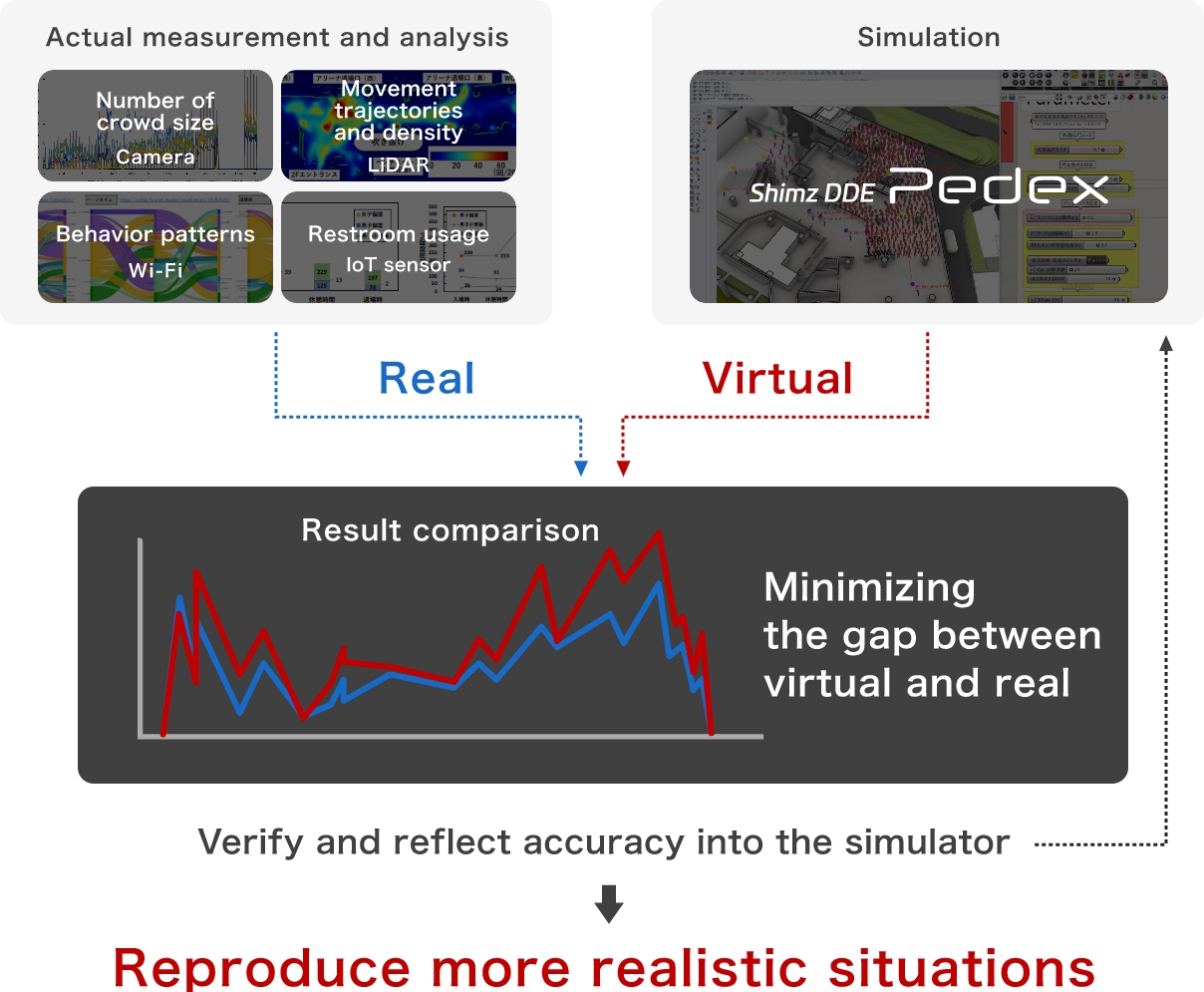
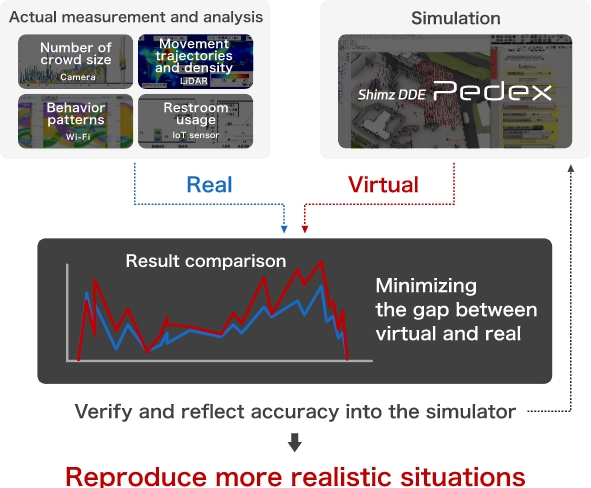
For example, this includes measuring the number of spectators and seat occupancy rates using cameras; identifying crowd walking speed, acceleration, and congestion points from distance and shape data captured by LiDAR; analyzing behavior patterns during stays via Wi Fi; and monitoring restroom usage with IoT sensors. By using movement objectives, routes, walking speeds, door positions/numbers/sizes, and corridor widths/lengths as input parameters and reflecting this data as needed, the system enhances precision and enables the refinement of design plans in a short period.
3
Shimz DDE Pedex+ Function
Best facility planning through design process innovation.
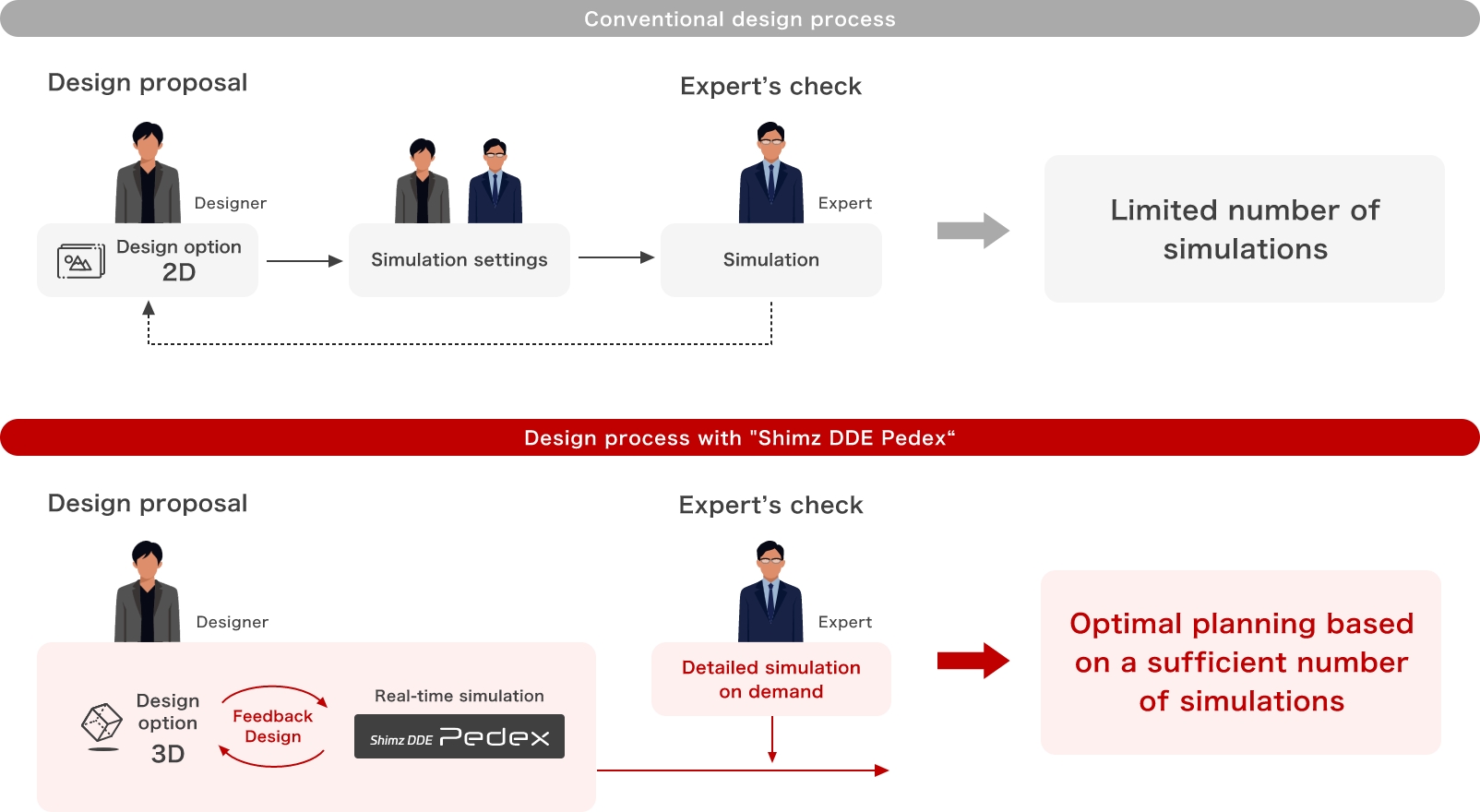
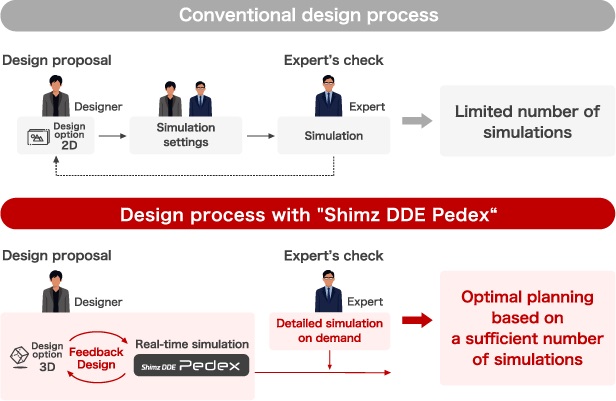
Conventionally, when designing large-scale facilities, the flow of “design proposal → condition setting → simulation by experts” was repeated, so it was common to proceed with design proposals only after policies were decided. However, this had limitations in terms of design period and cost. In contrast, the Shimz DDE Pedex+ design flow realizes innovation in the design process by combining 3D design proposals with real-time pedestrian flow simulation. This makes it possible to propose design plans that better align with needs based on simulation results from thousands of patterns.
New values brought by Shimz DDE Pedex+
1

All stakeholders can share the design process.
With clear judgment criteria through data visualization and an increased number of options, it becomes possible to select the optimal solution with consensus.
2
Design can be streamlined by minimizing man-hours.
Advanced simulation enables efficient design, allowing for higher-level collaboration with experts.
3

Facility validity can be evaluated at the initial stage.
Reflect the best flow planning into the design even at the planning stage, enabling consideration of safe and stress-free facility operations.
A joint development


Shimz DDE Pedex+ was born through joint development with Vector Research Institute, Inc. and Algorithm Design Lab. By fusing the advanced knowledge and technology of both companies, we have realized an innovative design process for pedestrian flow study.
Furthermore, it can be linked with various Shimz DDE tools.