

Achieving optimal acoustic spaces through data visualization and automated evaluationAcoustic Simulation

Problem
What challenges are involved in "creating good sound = acoustic design"?
An Evolving Acoustic Simulation for Halls and Theaters
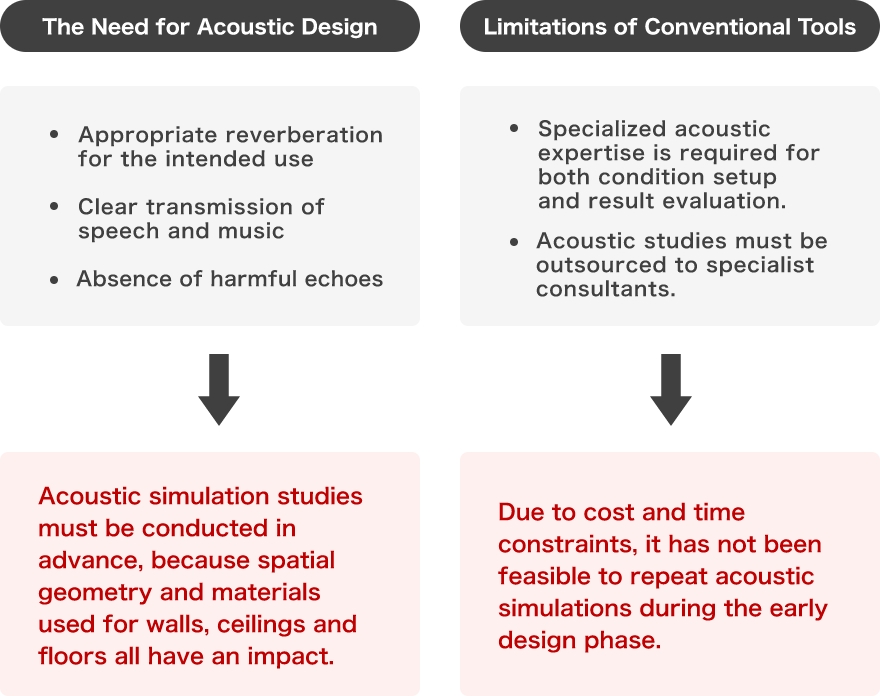
In spaces where acoustic quality is critical — such as music halls, theaters, and lecture rooms — it is essential to achieve appropriate reverberation for the intended use, ensure that music and speech are delivered clearly to the audience, and eliminate harmful echoes.
This is where acoustic simulation becomes indispensable.During the schematic design phase, it enables evaluation of acoustic performance for each design option and supports the study of room geometry and material selection for walls, ceilings, and floors.
However, while conventional simulation tools are highly capable and versatile, the involvement of acoustic specialists has been essential for interpreting results and proposing design improvements.During the early design phase — when numerous design options are being studied — it has been extremely difficult to conduct design studies and acoustic performance evaluations simultaneously with acoustic simulation integrated into the process.

Next-Generation Acoustic Simulation Enabled by Shimz DDE Audix
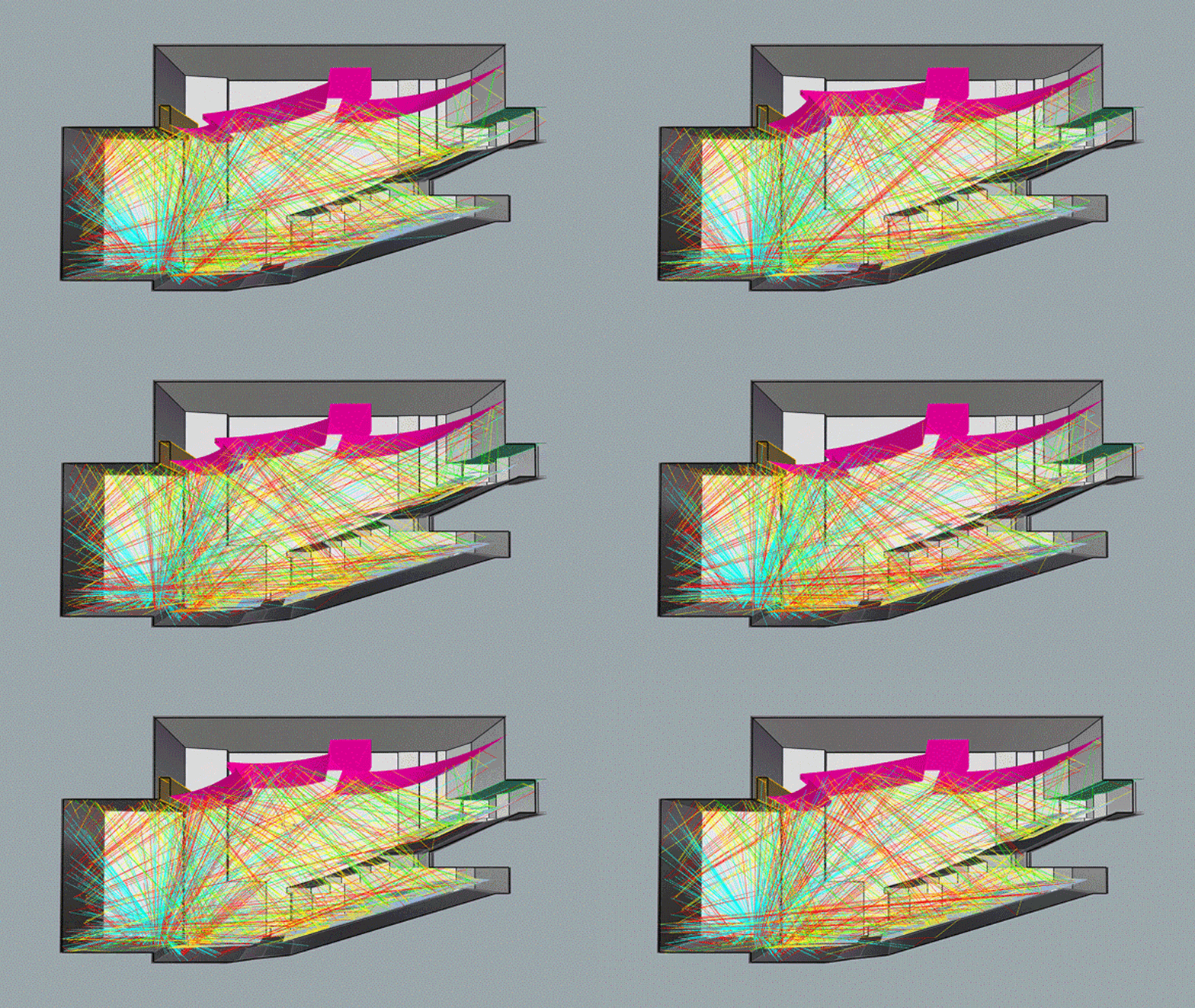
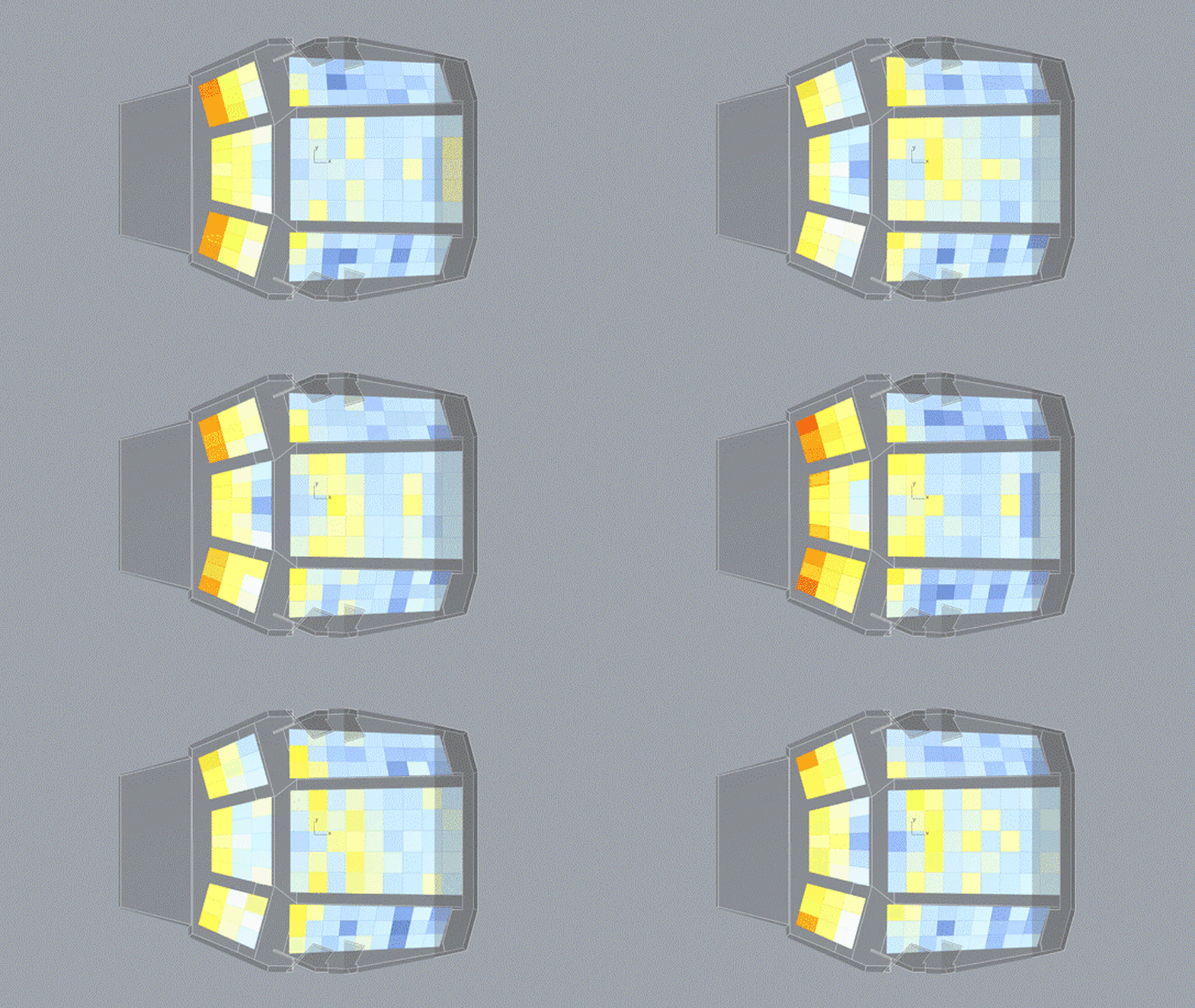
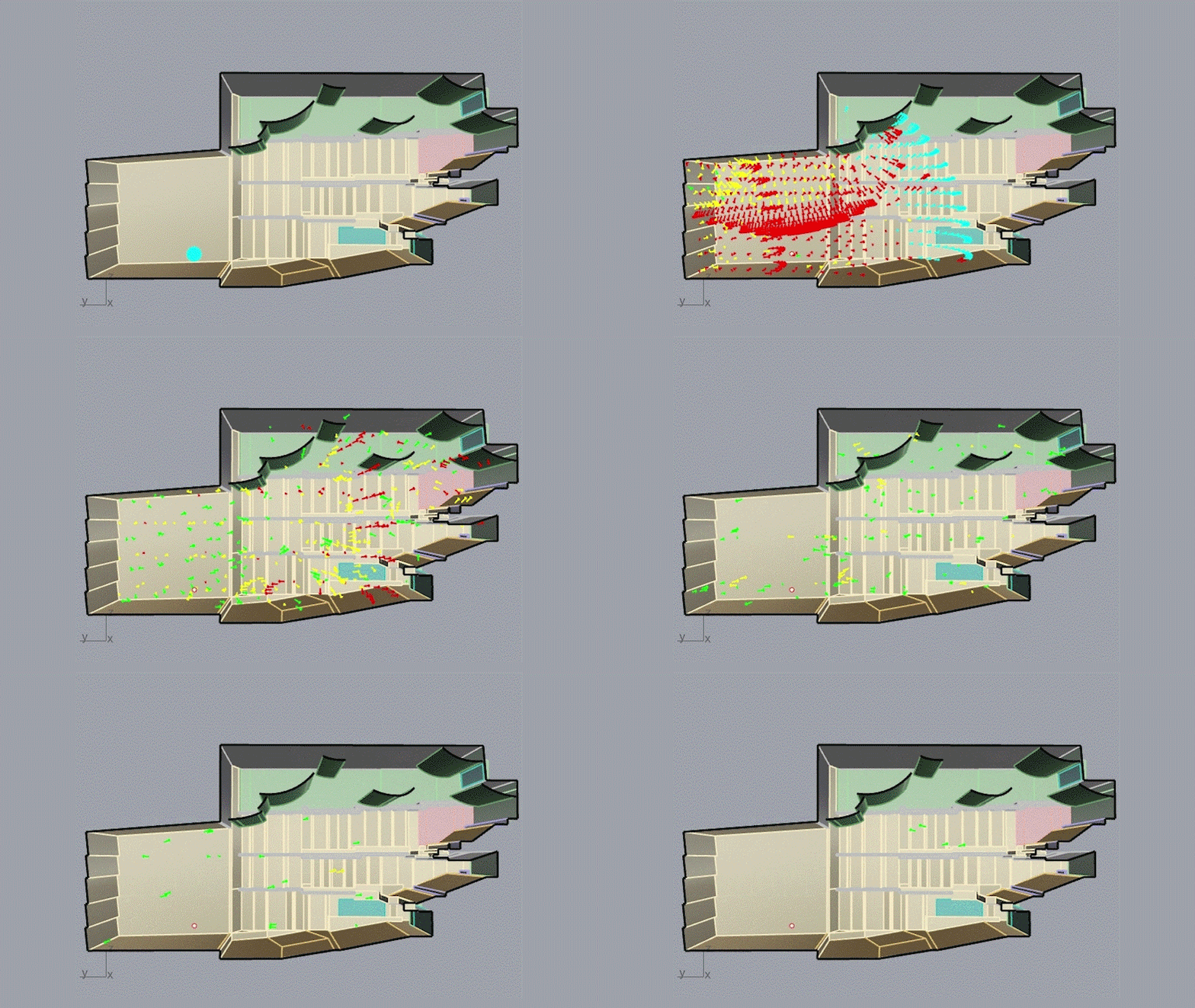
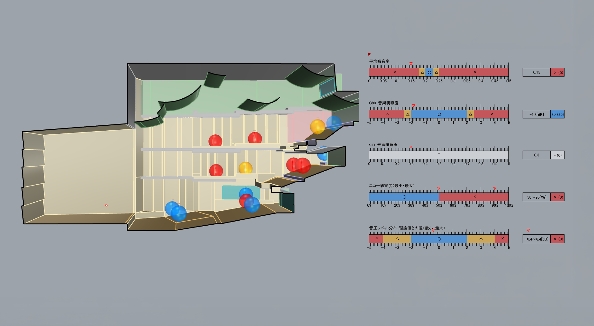
Shimz DDE Audix is a new acoustic simulation tool built on Rhinoceros and Grasshopper — the platforms designers use in their daily work — enabling simultaneous design study and acoustic performance evaluation for facilities where acoustic design is a key requirement.By setting parameters such as room geometry and finish material types — all of which affect acoustic performance — designers can instantly assess the suitability of acoustic performance for the intended use and select the most appropriate option.The tool also instantly generates a variety of visuals that allow even non-specialists to perceive acoustic performance intuitively.By bringing this level of specialized study directly into the hands of designers, Shimz DDE Audix aims to make acoustic design both more efficient and more advanced.
Features
Three Features That Open New Possibilities in Design
1
Features of Shimz DDE Audix
Built on Tools Familiar to Architectural Designers
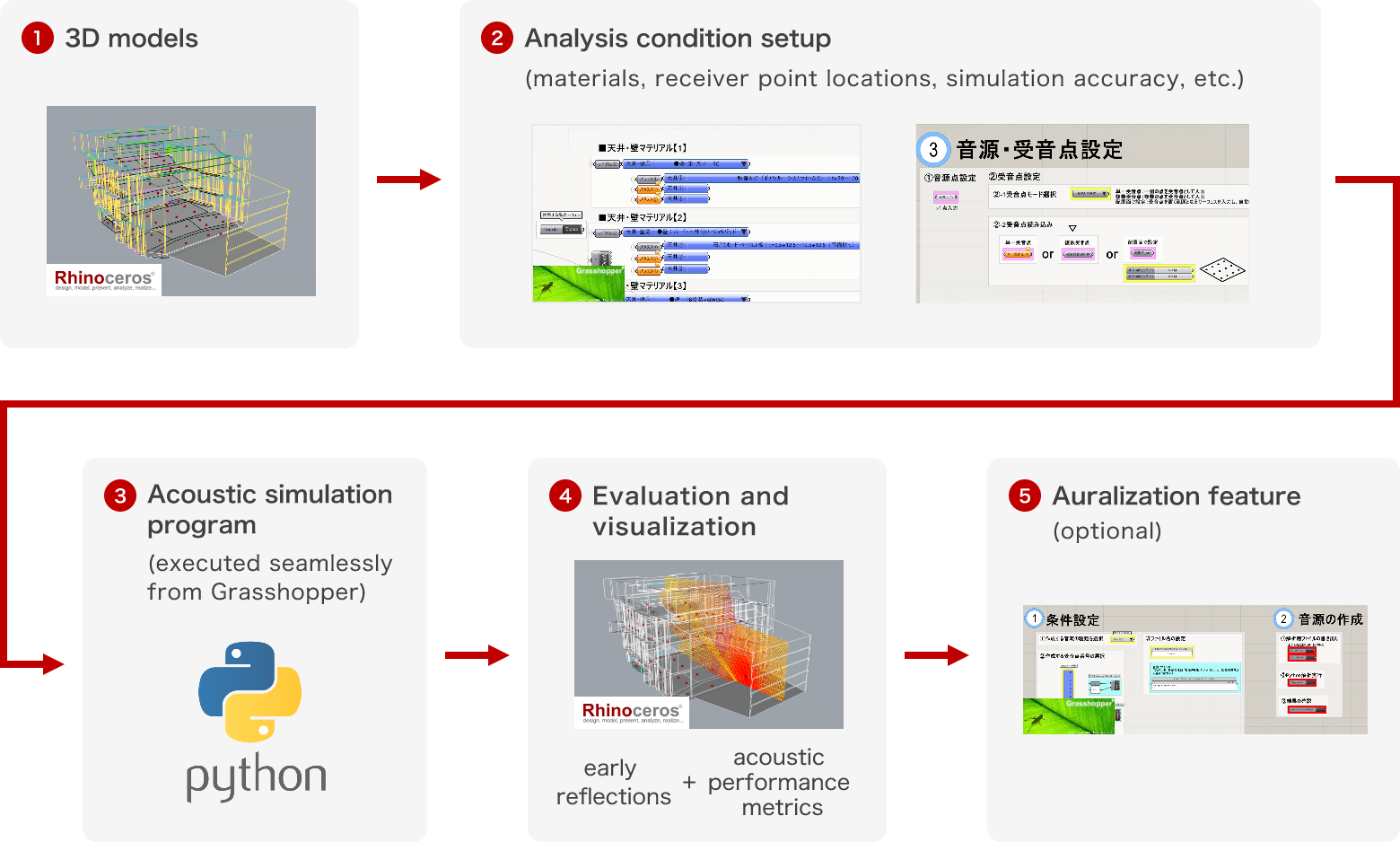
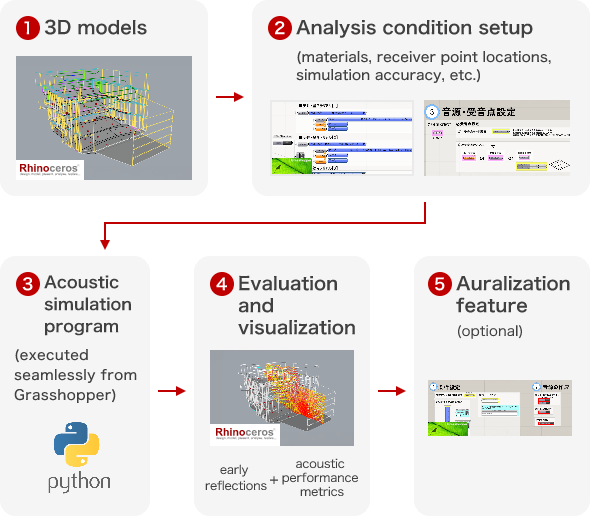
Unlike conventional acoustic prediction software, Shimz DDE Audix is built on Rhinoceros and Grasshopper — tools that architectural designers use as part of their everyday workflow.Working directly with 3D design study models created in Rhinoceros, users can configure finish material types and calculation conditions, run the predictive simulations described below, and evaluate results — all from within Grasshopper.The results generated by the simulation program are automatically judged as suitable or unsuitable against the pre-defined room use requirements, and the outcomes are visualized directly on the Rhino model.
2
Features of Shimz DDE Audix
Simulation Capabilities Tailored to Each Stage of the Design Process


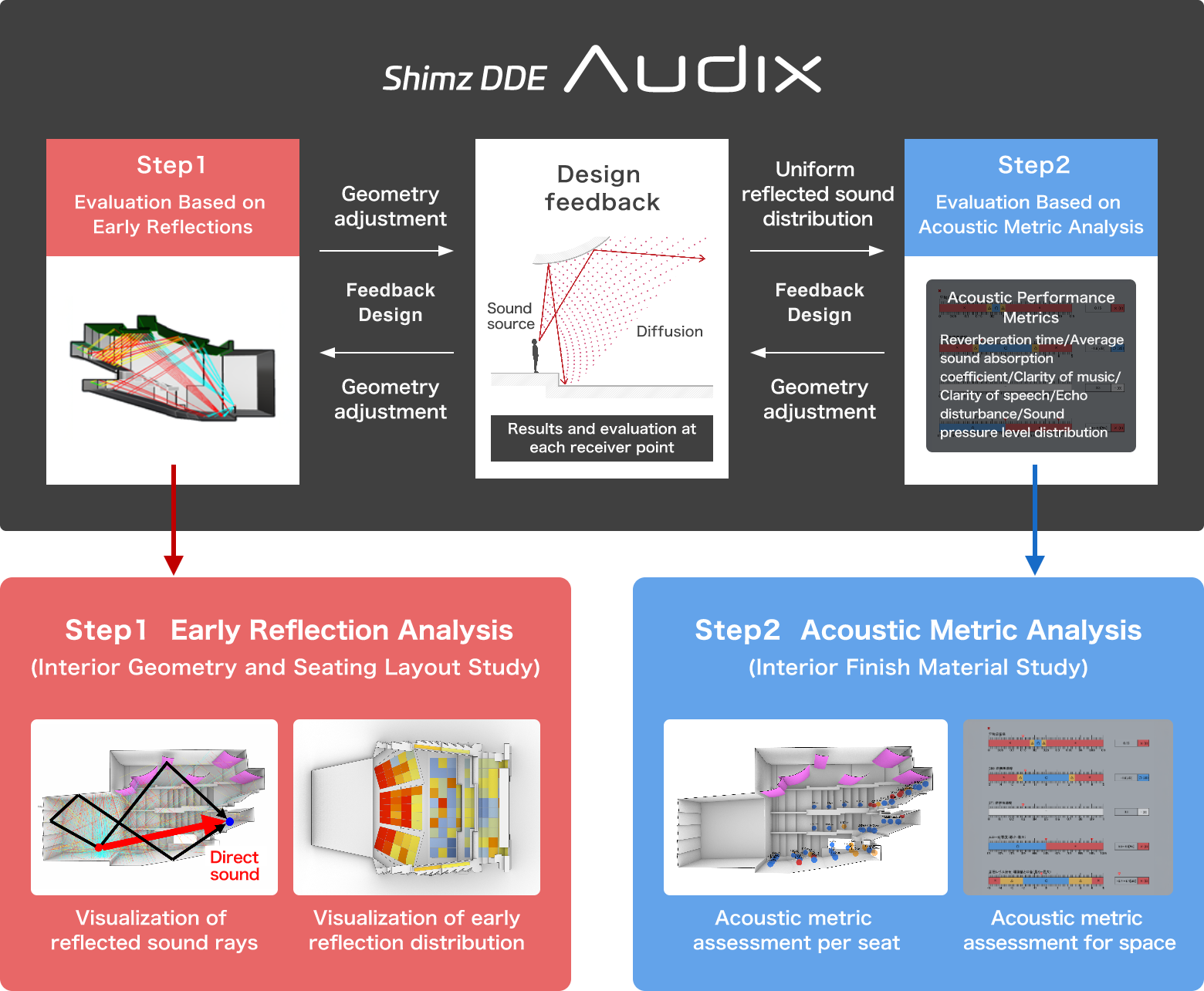
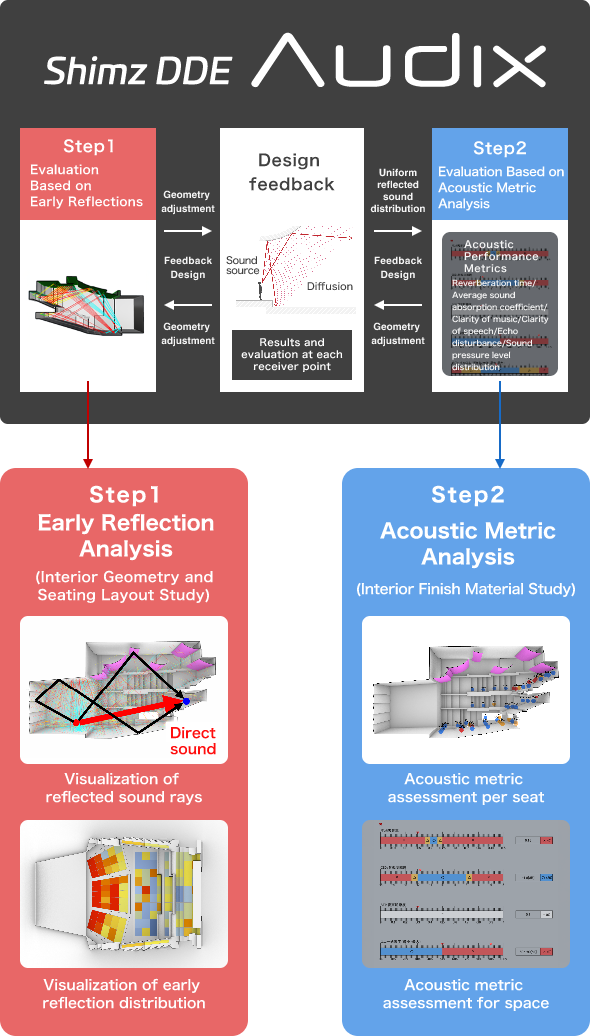
Shimz DDE Audix provides two simulation capabilities tailored to different stages of the design process.In the early design phase, the distribution of early reflections is studied in relation to the hall interior geometry and seating layout that serve as the basis for further study.The relatively light computational cost at this stage enables a large number of design studies, including parametric studies that automatically generate thousands of variations in hall interior geometry, such as ceiling and floor configurations.For the leading candidates narrowed down through this process, acoustic performance metrics such as reverberation time are calculated in detail, and the results are used to fine-tune the hall geometry and the materials and extent of sound-absorbing finishes.
3
Features of Shimz DDE Audix
Best facility planning through design process innovation.
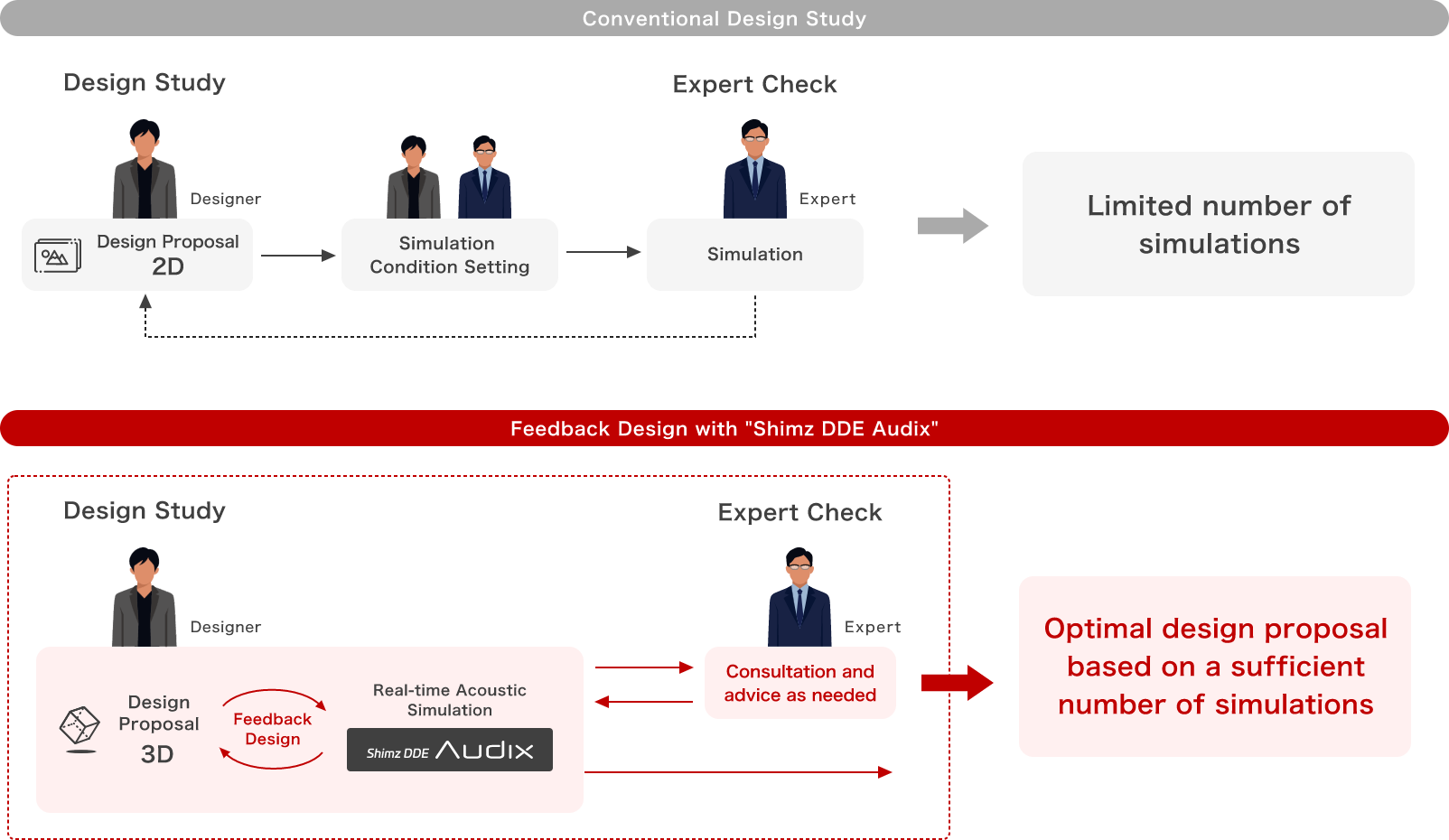
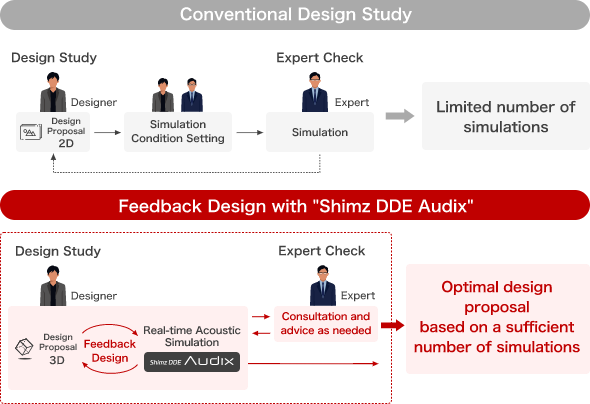
Conventional acoustic design has typically followed a repetitive cycle of "design proposal → condition setup → specialist simulation," which imposed constraints in terms of design schedule and cost. As a result, it was standard practice to begin acoustic design only after the overall design direction had been established.Shimz DDE Audix, in contrast, achieves innovation in the design process by integrating 3D design proposals with real-time acoustic simulation.This makes it possible to propose design plans that better align with needs based on simulation results from thousands of patterns.
New values brought by Shimz DDE Audix
1

Design process can be shared with customers.
With clear judgment criteria through data visualization and an increased number of options, it becomes possible to select the optimal solution with consensus.
2
Design can be streamlined by minimizing rework.
Advanced simulation enables efficient design, allowing for higher-level collaboration with experts.
3

Acoustic validity can be evaluated at the initial stage.
The results of acoustic performance studies are incorporated from the initial stages of designing seating arrangements and interior shape.
This allows for a well-balanced basic design in the early stages, enabling the pursuit of optimal acoustic performance in later stages.
Furthermore, it can be linked with various Shimz DDE tools.